Key Vocabulary Ch. 1:
Behaviorism- “Behavior can be learned or unlearned, and learning is the result of stimulus-and-response actions” (Tompkins, 2017, p.6). Explicit instruction is used until a student has mastered a skill. Behaviorism is teacher centered because of the teachers active role in teaching both discrete and subskills.
Constructivism- Student centered theory where students are active in constructing their own knowledge.
Schema Theory- “Describes how students learn” (Tompkins, 2017, p. 7). When familiar with a particular topic information is stored in a schema through a revision process called assimilation. However, if the topic is new and new schema is created through a difficult process called accomodation.
Inquiry Learning- Students create knowledge through collaboration and conductions investigations.
Engagement Theory- Those who are engaged have self-efficacy or “the confidence that they’ll succeed and reach their goals” (Tompkins, 2017, p. 8). Engaged learners are more motivated to read and or write and when they participate in activities that allow them to collaborate with classmates.
Sociolinguistics- A theory that “learners use language to organize their thoughs” (Tompkins, 2017, p. 8). When students talk with other students and or adults about what they are reading they can accomplish more challenging tasks.
Information Processing- “Compares the mind to a computer and describes how information moves through a series of processing units” (Tompkins, 2017, p. 10).
Phonological System- “The phonological system is important for both oral and written language”(Tompkins, 2017, p. 12). This system uses phonemes or sounds, graphemes or letters and phonics, which describes the phonemegrapheme correspondences and related spelling rules. “Comprehension is the goal of reading instruction” (Tompkins, 2017, p. 13).
Syntactic System- Structural organization that uses grammer to regulate words and their sentences, not parts of speech. Syntax or word forms are used as students read to help make the sequence of a sentence make sense (Tompkins, 2017, p. 13)
Semantic System- This system focuses on meaning with vocabulary as the key component (Tompkins, 2017, p. 13).
Pragmatic System- This system “deals with the social aspects of language use” (Tompkins, 2017, p.14). Dialects or language used in different social classes or ethnic groups reflect on the communities of the speakers.
Common Core Standards- Identifies what students should be learning at each grade level. Organized into five strands: Reading, writing, speaking and listening, language, and media and technology. The standards are research based, and relevant to real world problems to help students succeed.
Balanced Literacy Components- 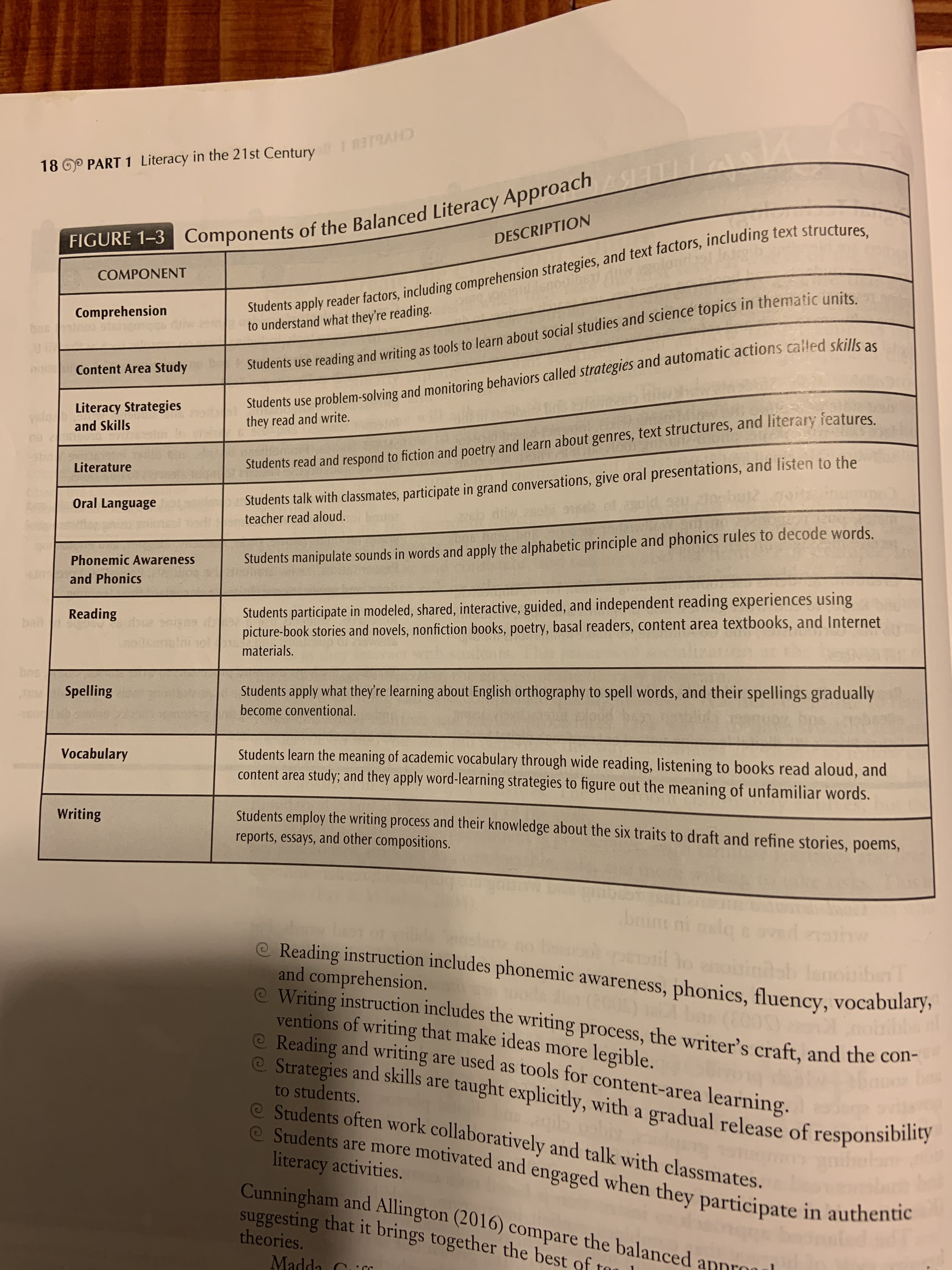
Application to the Classroom:
One thing more than anything that will relate to my future classroom is the common core standards. Understanding the five strands, reading, writing, speaking and listening, language, and media and technology and then each section under the five specific strands will ultimately set my classroom up for success.
One thing that wasn’t really an ah-ha moment but more of a this isn’t right moment is at the very beginning of the chapter where it states “that if students don’t do well, teachers are not effective”( Tompkins,2017, p.4) bothers me just a bit. Why? Tests don’t show a students growth or special talent in a particular area. Not to mention if we are all teaching the same standards then teachers shouldn’t be titled as ineffective simply because a few students are struggling to understand the content at hand. After all we all learn things in different ways.
References:
Tompkins, Gail E. Literacy for the 21st Century: a Balanced Approach. Pearson, 2017.
 Amanda Jachthuber