Vocab and Concepts:
Shared Reading: Teachers read big books and or poems written on charts, an activity that leads or serves as a lead in to the minilesson.
interactive reading: a read aloud where children both listen and engage in talking about the text
choral reading: students read a passage together. helps build fluency
guided reading: teacher works with small group of students whom are all at the same level with similiar reading behaviors. focuses on childs specific need
word wall: has high frequency words; is divided into sections for each letter of the alphabet; new words are introduced weekly; students use it as a resource to help spell words when writing.
mini lessons: used to teach literacy procedures, concepts, strategies, and skills.
interactive read-aloud-
Concepts of Print: the purposes of written language are demonstrated and provided through signs being posted in the classroom, making a list of classroom expectations, labeling classroom items, drawing and writing in journals, use of reading/writing materials in play centers, and reading and writing stories.
Concepts about words: concepts of words are developed through active participation such as watching teachers point to words, or by pointing to words in familiar texts.
Concepts about the alphabet: the most basic information learned about the alphabet is how to identify and form the letter in handwriting. Concepts are developed through a variety of components used to decode unfamiliar words.
Routines to teach the alphabet: 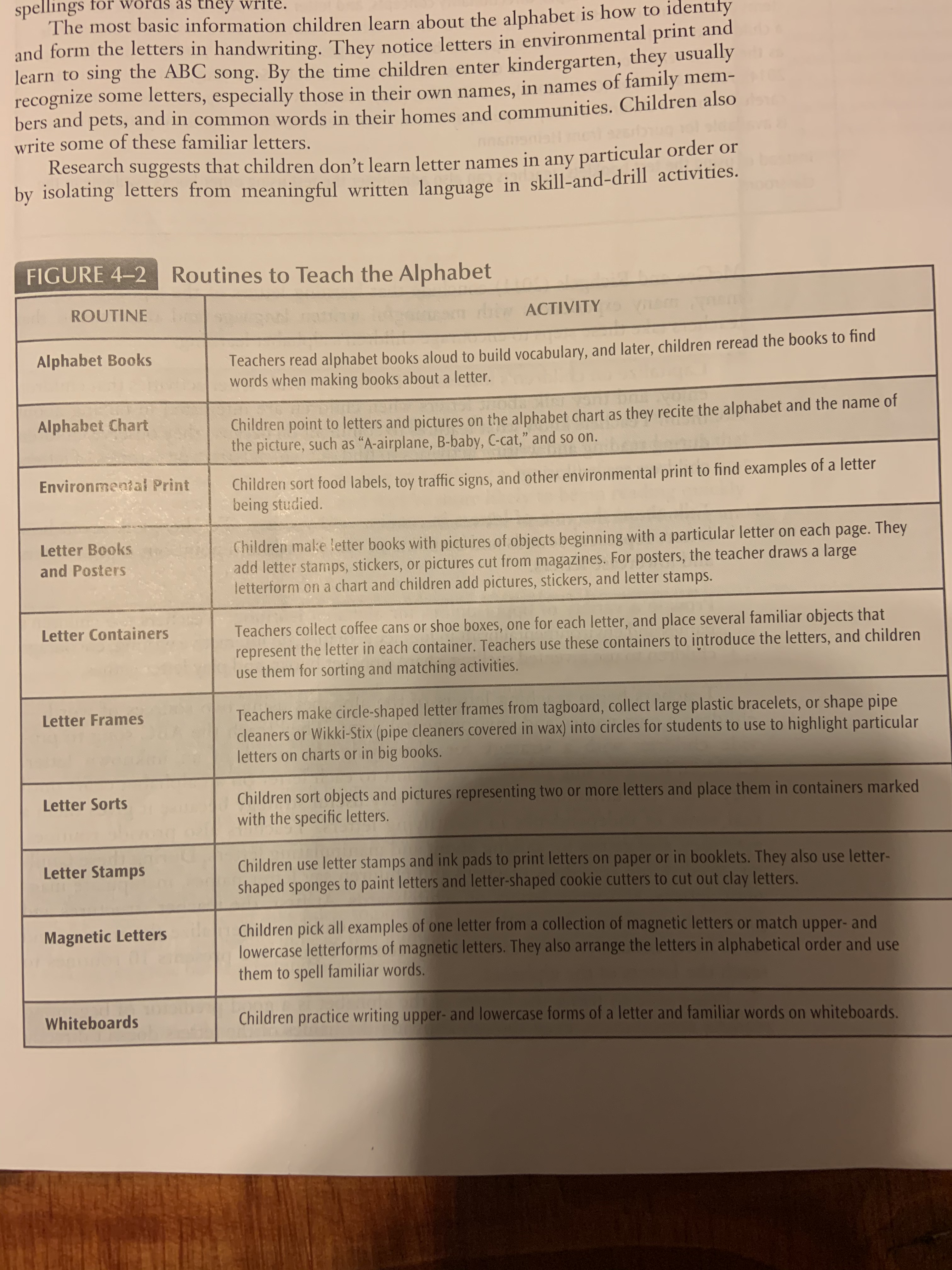
Environmental Print: signs, labels and other print found within the community
assessing concepts of written language: teachers observe and monitor children when looking at books or when writing to understand concepts being understood.
emergent reading and writing stage: in this stage children accomplish and interest in reading, acquire concepts about print, develop book handling skills, identify letters, develop handwriting skills and learn to read and write high-frequency words.
beginning reading and writing stage: marks the students growing awareness of alphabetic principle. They learn about phoneme-grapheme correspondences, phonics, word families and apply and misapply their developing phonics knowledge to spell words.
fluent reading and writing stage: in this stage students accomplish fluently reading with expression, recognize one syllable words, use decoding and comprehension strategies, spell most high-frequency word, and use capital letters and punctuation marks correctly.
morning message: daily literacy routine used to teach literacy concepts, strategies and skills. Brief message about what the day will look like.
predictable books: books that have repeated sentences, rhyme or other patterns.
language experience approach: teachers use shared writing where student dictates words or sentences about their experiences and the teacher writes it down.
interactive writing: text is created together by both student and teacher. Children compose a message and then teacher guides them as they write it word for word on the chart.
manuscript writing: focuses on holding a writing utensil the correct way and focusing on letter formation. Teachers model for students and then watch students
Blooms Taxonomy: six levels: knowledge/remembering- student recalls and or recognizes information or ideas in the approximate form in which they were learned. comprehension/understanding- student translates information based on prior learning. application/applying- student selects and uses data to complete a problem with minimum direction. analysis/analyzing- student can distinguish and relate assumptions, evidence or structure of a statement or question. synthesis/evaluating- student originates and combines ideas into a product, plan or proposal that is new to him/her. evaluation- student appraises or critiques on basis of specific standards and criteria.
Application to the classroom: This chapter has helped me to better understand how to nurture a students oral language development and foster their interest in literacy. Furthermore it gave me understanding on how to match instructional activities to the students stage of reading and writing development.
 Amanda Jachthuber