Amanda Jachthuber, EngEd275, Ch. 1 5-9 Principle

Summary of what was learned through the discussions: “Effective teachers demonstrate their responsibility and commitment to ensuring that their students are successful when they adopt to the nine principles” (Tompkins, 2017, p.32). One thing I learned that is most important in my own personal opinion from week twos discussion is that in order to have all the other principles fall into place and work a classroom culture (principle three) needs to be created from day one and built upon as the year goes on. Week three’s discussion really focused on the variety of reading topics and what works best for particular situations. One thing that I gathered from this discussion is that “no single instructional program best represents the balanced approach to literacy; instead teachers organize instruction by creating something that fits their students needs but follows the standards or curricular guidlines” (Tompkins, 2017, p. 24).

Vocabulary:

Principle 5- Teachers address standards in the classroom

Principle 6- Teachers support students reading and writing development

Principle 7- How teachers organize instruction using more than just one program

Principle 8- How teachers differentiate instruction so that everyone in the classroom can be successful

Principle 9- How instruction and assessments are linked

scaffolding- helps a student to solve a problem, carry out a given task or reach a goal through gradual shedding of outside assistance.

shared reading- teacher does most of the reading and children are asked to join in to read familiar words and or phrases. Teachers use it to read big books to younger children

Language Experience Approach- students suggest words and or sentences that the teacher writes on a chart

choral reading- one example of interactive reading where students take turns reading lines or sentences

readers theatre- a second example of interactive reading where students take on roles of characters and read lines that are in a script

interactive writing- an activity where both students and teacher create a text and write a message. Text is composed by the group of students and the teacher will assist as the students write the text on a chart paper

guided reading- students read and listen to leveled books chose by the teacher through online resources

literature circles- students read or listen to books, complete a role assignment, research topics online and create a wiki about the book to share with others

differentiation- involves adjusting the content, the process and the product. Vygotsky’s idea of zone of proximal development

Nuturing English Learners- use of explicit instruction, use of oral language, small group work, reading aloud, knowing background info, authentic literacy activities. They must participate in the same instructional programs.

assessment- an integral and ongoing part of learning and teaching

running records- formative assessment used to document teacher observations of students errors and corrections

linking instruction and assessments in four steps- step 1-planning-uses knowledge knnown, step 2-monitoring- look at progress while observing, conferencing and checking work and then make modifications if needed, step 3-evaluating- use of rubrics and checklists to assess projects and collect samplesand step 4-reflecting– judge effectiveness of instruction and think about how they can adapt instruction to improve learing

rubrics- a guide to evaluate students work

Application to the classroom: This section of chapter one focuses on how to organize instruction to better support students in their reading and writing development. Which will help me link both instruction and assessment so that all my students can be successful. One thing I need to remember is the instruction-assessment cycle so that I am not blaming my students when they don’t understand something.
Amanda Jachthuber, EngEd 275, Chapter 1:Becoming and Effective Literacy Teacher

Key Vocabulary Ch. 1:

Behaviorism- “Behavior can be learned or unlearned, and learning is the result of stimulus-and-response actions” (Tompkins, 2017, p.6). Explicit instruction is used until a student has mastered a skill. Behaviorism is teacher centered because of the teachers active role in teaching both discrete and subskills.

Constructivism- Student centered theory where students are active in constructing their own knowledge.

Schema Theory- “Describes how students learn” (Tompkins, 2017, p. 7). When familiar with a particular topic information is stored in a schema through a revision process called assimilation. However, if the topic is new and new schema is created through a difficult process called accomodation.

Inquiry Learning- Students create knowledge through collaboration and conductions investigations.

Engagement Theory- Those who are engaged have self-efficacy or “the confidence that they’ll succeed and reach their goals” (Tompkins, 2017, p. 8). Engaged learners are more motivated to read and or write and when they participate in activities that allow them to collaborate with classmates.

Sociolinguistics- A theory that “learners use language to organize their thoughs” (Tompkins, 2017, p. 8). When students talk with other students and or adults about what they are reading they can accomplish more challenging tasks.

Information Processing- “Compares the mind to a computer and describes how information moves through a series of processing units” (Tompkins, 2017, p. 10).

Phonological System- “The phonological system is important for both oral and written language”(Tompkins, 2017, p. 12). This system uses phonemes or sounds, graphemes or letters and phonics, which describes the phonemegrapheme correspondences and related spelling rules. “Comprehension is the goal of reading instruction” (Tompkins, 2017, p. 13).

Syntactic System- Structural organization that uses grammer to regulate words and their sentences, not parts of speech. Syntax or word forms are used as students read to help make the sequence of a sentence make sense (Tompkins, 2017, p. 13)

Semantic System- This system focuses on meaning with vocabulary as the key component (Tompkins, 2017, p. 13).

Pragmatic System- This system “deals with the social aspects of language use” (Tompkins, 2017, p.14). Dialects or language used in different social classes or ethnic groups reflect on the communities of the speakers.

Common Core Standards- Identifies what students should be learning at each grade level. Organized into five strands: Reading, writing, speaking and listening, language, and media and technology. The standards are research based, and relevant to real world problems to help students succeed.

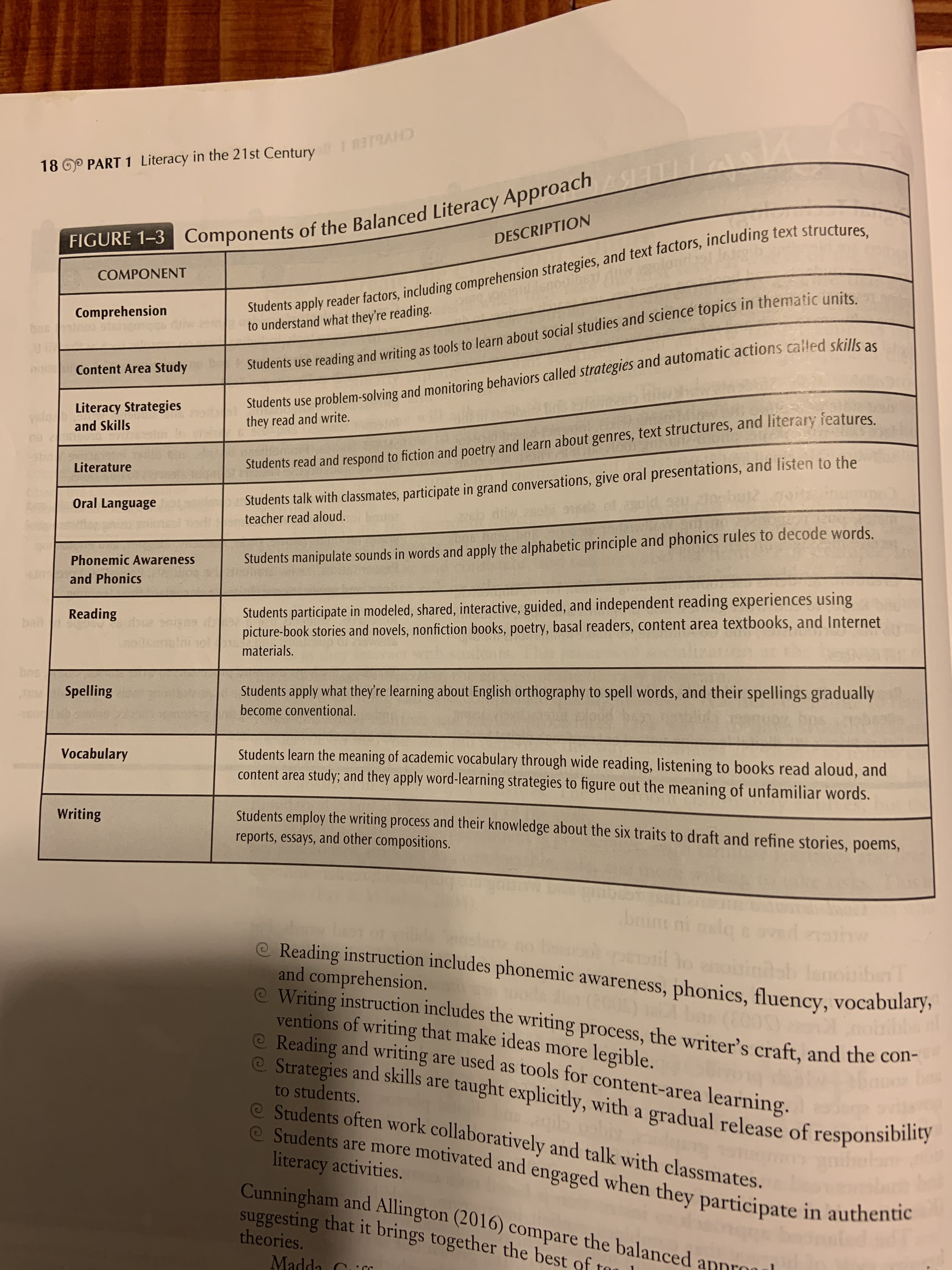
Balanced Literacy Components-

Application to the Classroom:

One thing more than anything that will relate to my future classroom is the common core standards. Understanding the five strands, reading, writing, speaking and listening, language, and media and technology and then each section under the five specific strands will ultimately set my classroom up for success.

One thing that wasn’t really an ah-ha moment but more of a this isn’t right moment is at the very beginning of the chapter where it states “that if students don’t do well, teachers are not effective”( Tompkins,2017, p.4) bothers me just a bit. Why? Tests don’t show a students growth or special talent in a particular area. Not to mention if we are all teaching the same standards then teachers shouldn’t be titled as ineffective simply because a few students are struggling to understand the content at hand. After all we all learn things in different ways.

References:

Tompkins, Gail E. Literacy for the 21st Century: a Balanced Approach. Pearson, 2017.

Amanda Jachthuber, EngEd275, Ch. 1 5-9 Principle

Summary of what was learned through the discussions: “Effective teachers demonstrate their responsibility and commitment to ensuring that their students are successful when they adopt to the nine principles” (Tompkins, 2017, p.32). One thing I learned that is most important in my own personal opinion from week twos discussion is that in order to have all the other principles fall into place and work a classroom culture (principle three) needs to be created from day one and built upon as the year goes on. Week three’s discussion really focused on the variety of reading topics and what works best for particular situations. One thing that I gathered from this discussion is that “no single instructional program best represents the balanced approach to literacy; instead teachers organize instruction by creating something that fits their students needs but follows the standards or curricular guidlines” (Tompkins, 2017, p. 24).

Vocabulary:

Principle 5- Teachers address standards in the classroom

Principle 6- Teachers support students reading and writing development

Principle 7- How teachers organize instruction using more than just one program

Principle 8- How teachers differentiate instruction so that everyone in the classroom can be successful

Principle 9- How instruction and assessments are linked

scaffolding- helps a student to solve a problem, carry out a given task or reach a goal through gradual shedding of outside assistance.

shared reading- teacher does most of the reading and children are asked to join in to read familiar words and or phrases. Teachers use it to read big books to younger children

Language Experience Approach- students suggest words and or sentences that the teacher writes on a chart

choral reading- one example of interactive reading where students take turns reading lines or sentences

readers theatre- a second example of interactive reading where students take on roles of characters and read lines that are in a script

interactive writing- an activity where both students and teacher create a text and write a message. Text is composed by the group of students and the teacher will assist as the students write the text on a chart paper

guided reading- students read and listen to leveled books chose by the teacher through online resources

literature circles- students read or listen to books, complete a role assignment, research topics online and create a wiki about the book to share with others

differentiation- involves adjusting the content, the process and the product. Vygotsky’s idea of zone of proximal development

Nuturing English Learners- use of explicit instruction, use of oral language, small group work, reading aloud, knowing background info, authentic literacy activities. They must participate in the same instructional programs.

assessment- an integral and ongoing part of learning and teaching

running records- formative assessment used to document teacher observations of students errors and corrections

linking instruction and assessments in four steps- step 1-planning-uses knowledge knnown, step 2-monitoring- look at progress while observing, conferencing and checking work and then make modifications if needed, step 3-evaluating- use of rubrics and checklists to assess projects and collect samplesand step 4-reflecting– judge effectiveness of instruction and think about how they can adapt instruction to improve learing

rubrics- a guide to evaluate students work

Application to the classroom: This section of chapter one focuses on how to organize instruction to better support students in their reading and writing development. Which will help me link both instruction and assessment so that all my students can be successful. One thing I need to remember is the instruction-assessment cycle so that I am not blaming my students when they don’t understand something.

Amanda Jachthuber, EngEd 275, Chapter 1:Becoming and Effective Literacy Teacher

Key Vocabulary Ch. 1:

Behaviorism- “Behavior can be learned or unlearned, and learning is the result of stimulus-and-response actions” (Tompkins, 2017, p.6). Explicit instruction is used until a student has mastered a skill. Behaviorism is teacher centered because of the teachers active role in teaching both discrete and subskills.

Constructivism- Student centered theory where students are active in constructing their own knowledge.

Schema Theory- “Describes how students learn” (Tompkins, 2017, p. 7). When familiar with a particular topic information is stored in a schema through a revision process called assimilation. However, if the topic is new and new schema is created through a difficult process called accomodation.

Inquiry Learning- Students create knowledge through collaboration and conductions investigations.

Engagement Theory- Those who are engaged have self-efficacy or “the confidence that they’ll succeed and reach their goals” (Tompkins, 2017, p. 8). Engaged learners are more motivated to read and or write and when they participate in activities that allow them to collaborate with classmates.

Sociolinguistics- A theory that “learners use language to organize their thoughs” (Tompkins, 2017, p. 8). When students talk with other students and or adults about what they are reading they can accomplish more challenging tasks.

Information Processing- “Compares the mind to a computer and describes how information moves through a series of processing units” (Tompkins, 2017, p. 10).

Phonological System- “The phonological system is important for both oral and written language”(Tompkins, 2017, p. 12). This system uses phonemes or sounds, graphemes or letters and phonics, which describes the phonemegrapheme correspondences and related spelling rules. “Comprehension is the goal of reading instruction” (Tompkins, 2017, p. 13).

Syntactic System- Structural organization that uses grammer to regulate words and their sentences, not parts of speech. Syntax or word forms are used as students read to help make the sequence of a sentence make sense (Tompkins, 2017, p. 13)

Semantic System- This system focuses on meaning with vocabulary as the key component (Tompkins, 2017, p. 13).

Pragmatic System- This system “deals with the social aspects of language use” (Tompkins, 2017, p.14). Dialects or language used in different social classes or ethnic groups reflect on the communities of the speakers.

Common Core Standards- Identifies what students should be learning at each grade level. Organized into five strands: Reading, writing, speaking and listening, language, and media and technology. The standards are research based, and relevant to real world problems to help students succeed.

Balanced Literacy Components-

Application to the Classroom:

One thing more than anything that will relate to my future classroom is the common core standards. Understanding the five strands, reading, writing, speaking and listening, language, and media and technology and then each section under the five specific strands will ultimately set my classroom up for success.

One thing that wasn’t really an ah-ha moment but more of a this isn’t right moment is at the very beginning of the chapter where it states “that if students don’t do well, teachers are not effective”( Tompkins,2017, p.4) bothers me just a bit. Why? Tests don’t show a students growth or special talent in a particular area. Not to mention if we are all teaching the same standards then teachers shouldn’t be titled as ineffective simply because a few students are struggling to understand the content at hand. After all we all learn things in different ways.

References:

Tompkins, Gail E. Literacy for the 21st Century: a Balanced Approach. Pearson, 2017.

Amanda Jachthuber, EngEd 275, Chapter 1:Becoming and Effective Literacy Teacher

Key Vocabulary Ch. 1:

Behaviorism- “Behavior can be learned or unlearned, and learning is the result of stimulus-and-response actions” (Tompkins, 2017, p.6). Explicit instruction is used until a student has mastered a skill. Behaviorism is teacher centered because of the teachers active role in teaching both discrete and subskills.

Constructivism- Student centered theory where students are active in constructing their own knowledge.

Schema Theory- “Describes how students learn” (Tompkins, 2017, p. 7). When familiar with a particular topic information is stored in a schema through a revision process called assimilation. However, if the topic is new and new schema is created through a difficult process called accomodation.

Inquiry Learning- Students create knowledge through collaboration and conductions investigations.

Engagement Theory- Those who are engaged have self-efficacy or “the confidence that they’ll succeed and reach their goals” (Tompkins, 2017, p. 8). Engaged learners are more motivated to read and or write and when they participate in activities that allow them to collaborate with classmates.

Sociolinguistics- A theory that “learners use language to organize their thoughs” (Tompkins, 2017, p. 8). When students talk with other students and or adults about what they are reading they can accomplish more challenging tasks.

Information Processing- “Compares the mind to a computer and describes how information moves through a series of processing units” (Tompkins, 2017, p. 10).

Phonological System- “The phonological system is important for both oral and written language”(Tompkins, 2017, p. 12). This system uses phonemes or sounds, graphemes or letters and phonics, which describes the phonemegrapheme correspondences and related spelling rules. “Comprehension is the goal of reading instruction” (Tompkins, 2017, p. 13).

Syntactic System- Structural organization that uses grammer to regulate words and their sentences, not parts of speech. Syntax or word forms are used as students read to help make the sequence of a sentence make sense (Tompkins, 2017, p. 13)

Semantic System- This system focuses on meaning with vocabulary as the key component (Tompkins, 2017, p. 13).

Pragmatic System- This system “deals with the social aspects of language use” (Tompkins, 2017, p.14). Dialects or language used in different social classes or ethnic groups reflect on the communities of the speakers.

Common Core Standards- Identifies what students should be learning at each grade level. Organized into five strands: Reading, writing, speaking and listening, language, and media and technology. The standards are research based, and relevant to real world problems to help students succeed.

Balanced Literacy Components-

Application to the Classroom:

One thing more than anything that will relate to my future classroom is the common core standards. Understanding the five strands, reading, writing, speaking and listening, language, and media and technology and then each section under the five specific strands will ultimately set my classroom up for success.

One thing that wasn’t really an ah-ha moment but more of a this isn’t right moment is at the very beginning of the chapter where it states “that if students don’t do well, teachers are not effective”( Tompkins,2017, p.4) bothers me just a bit. Why? Tests don’t show a students growth or special talent in a particular area. Not to mention if we are all teaching the same standards then teachers shouldn’t be titled as ineffective simply because a few students are struggling to understand the content at hand. After all we all learn things in different ways.

References:

Tompkins, Gail E. Literacy for the 21st Century: a Balanced Approach. Pearson, 2017.

Design a site like this with WordPress.com
Get started