Amanda Jachthuber, EngEd 275, Ch. 12 Reading and Writing Across the Curriculum

Key Vocab and Concepts:

Trade Books – Not a textbook but a published book that is found in libraries or book stores

Text Set- A collection of fiction and nonfiction books and digital resources at varied reading levels on a topic.

Mentor Texts- pieces of literature that both teacher and student can re-read for a variety of purposes such as helping to make their writing more purposeful and powerful.

Learning Logs- students use learning logs to record and react to what they are learning in different content areas. They allow students to think on paper. They help students discover gaps in their knowledge and explore relationships between what they are learning and what they know.

Double-Entry Journals- Journals where the pages are divided into two parts and students write different types of information in each section. For example in one section the write important facts and their reactions to the information in the other section.

Quickwriting- where students write for 5-10 minutes letting their thoughts flow from mind to paper without focusing on mechanics or revisions. Younger children may draw pictures. Quickwriting is used to activate background knowledge at the beginning of a lesson or unit and help clarify misconceptions.

Essays- Are short usually no longer than two pages and used to explain, analyze and persuade.

Collaborative Books- Books that are written by students. Sometimes each student will write one page each or even work in groups to write chapters.

Anticipation Guides- are a set of statements on the topic of the chapter where students agree or disagree with the statements and then they read the assignment to see if they were right.

Pre-reading Plan – A plan in which the teacher presents an idea discussed in the chapter and then they have students brainstorm words and ideas that are related to the idea.

Question-Answer Relationships- a technique that helps understand how to answer questions written at the end of content area textbook chapters. It teaches students to become aware of whether they are likely to find the answer to a question ‘right there’ on a page, between the lines or beyond information that is provided within the text.

Stages of Reading Process- Stage 1: Pre-reading- building of background knowledge on topic, preview of text, introduction of big ideas and technical words. Stage 2: Reading- In this stage teachers help students identify big ideas and organize them. Stage 3: Responding- teachers help students refine their comprehension through thinking, talking and writing. Stage 4: Exploring- Students are asked to dig into the text and focus on vocabulary, examine the text and analyze big ideas. Stage 5: Applying- Teachers help expand the knowledge on the topic, encourage students to personalize their learning and share what they know.

Semantic Feature Analysis- A chart that classifies important information or big ideas

SQ4R Study Strategy- a six step technique where students survey, question, read, recite, relate, and review as they study content area reading assignments. This strategy incorporates before, during and after-reading components.

How to plan a Thematic Unit- To plan a thematic unit teachers go through nine steps that include determining the focus, collecting a text set, coordinating textbook readings, locating digital and multimedia material, planning instructional activities, identifying minilesson topics, planning ways to differentiate instruction, brainstorming possible projects and planning for assessment. Once that is done they are prepared to develop a time schedule, write the lesson plans, and create rubrics or other assessment tools.

Alternative Assessments- Examples include: drawing a picture instead of writing, give the answers to test questions orally instead of having them do it in written form. If students need to create written work its best if done in a group setting.

Application to Classroom- I will be an effective teacher by developing thematic units, teaching minilessons to ensure comprehension, and use the reading/writing tools to help my students demonstrate new knowledge.
Amanda Jachthuber, EngEd 275, Ch. 11 Differentiating for Success

Key Vocab and Concepts:

Differentiation- means “shaking up” what goes on in the classroom so that students have multiple options for taking in information, making sense of ideas, and expressing what they learn.

Differentiating the Content- Content is the ‘what’ of teaching and reflects Common Core grade-level standards. Teachers concentrate on essential content to meet student needs and then provide more instruction/practice for some or less for others. If students are familiar with content the increase the complexity of instructional activities. Students are assessed and then matched with appropriate activities.

Differentiating the Process- Process is the ‘how’ of teaching. This includes the instruction provided, materials used, and activities involved to make students successful. Students are grouped for instruction and given reading material appropriate for their level. Decisions about involving students in activities that allow them to apply what was learned through oral, written or visual means.

Differentiating the Product- Product is the result of what was learned. It shows what students understand and how well they can apply what was learned. Projects such as posters, board games, multimodal reports or even a puppet show are created. The complexity of projects vary by the level of thinking that is required to complete the project.

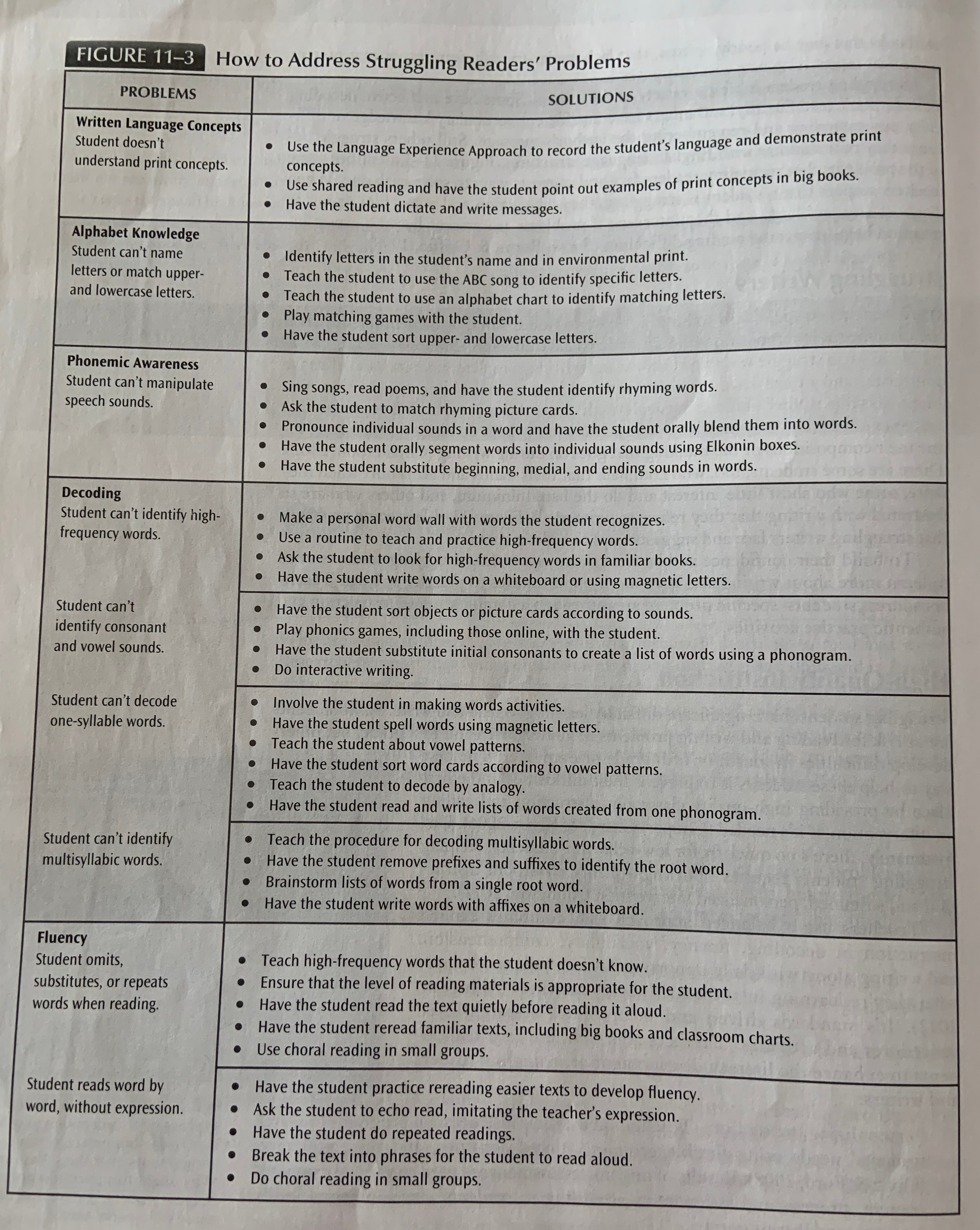
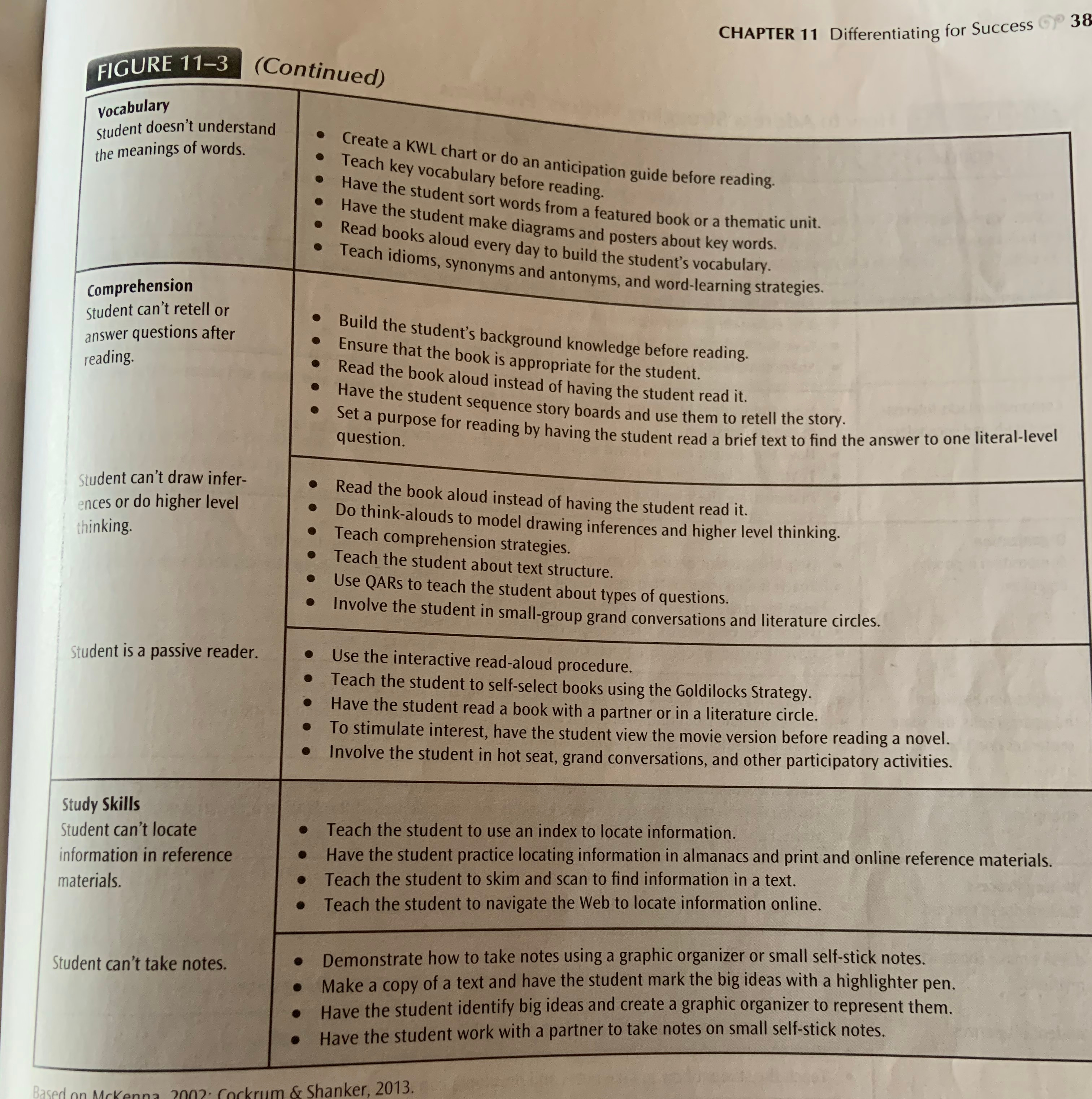
How to address struggling readers problems-

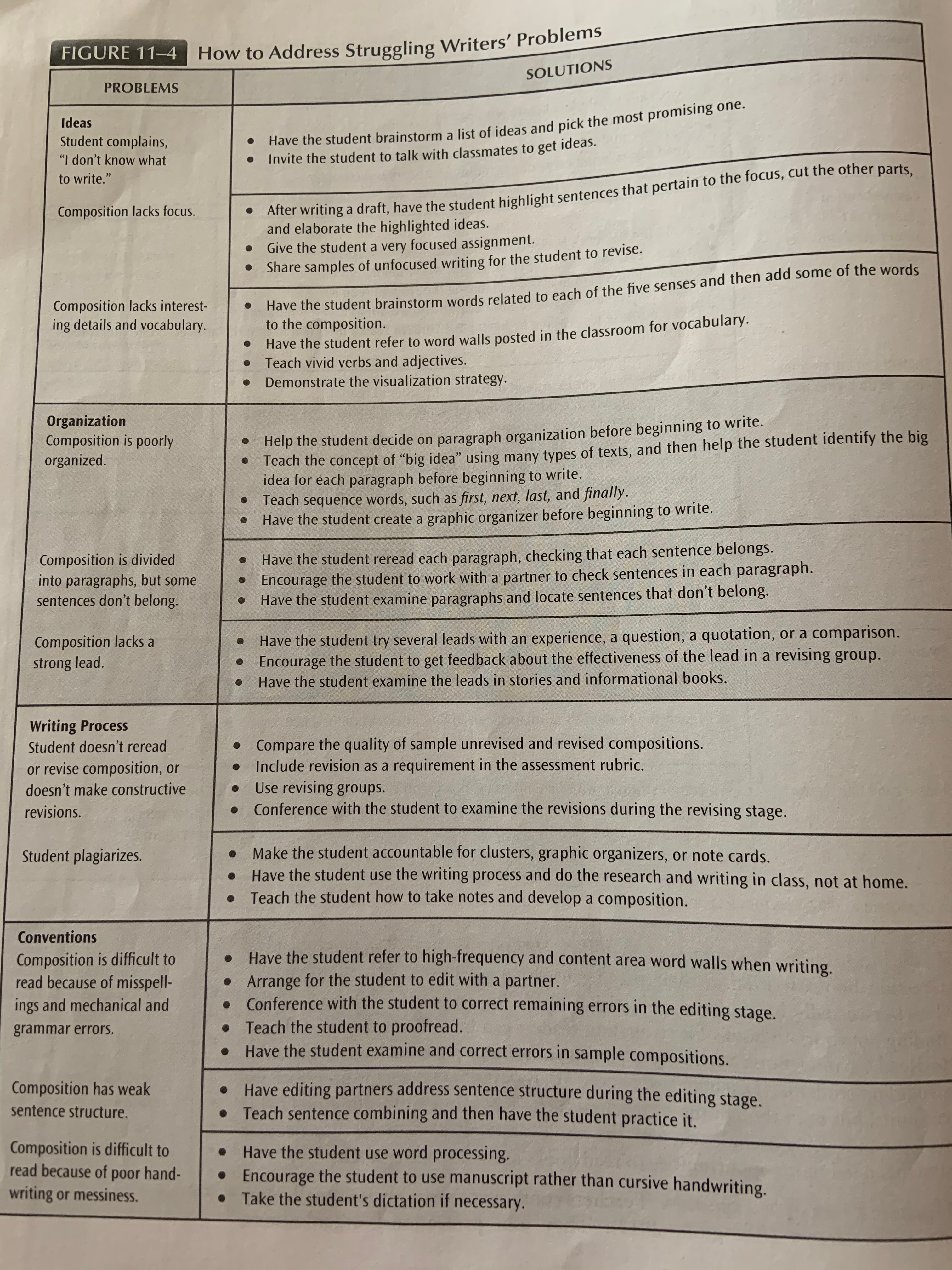
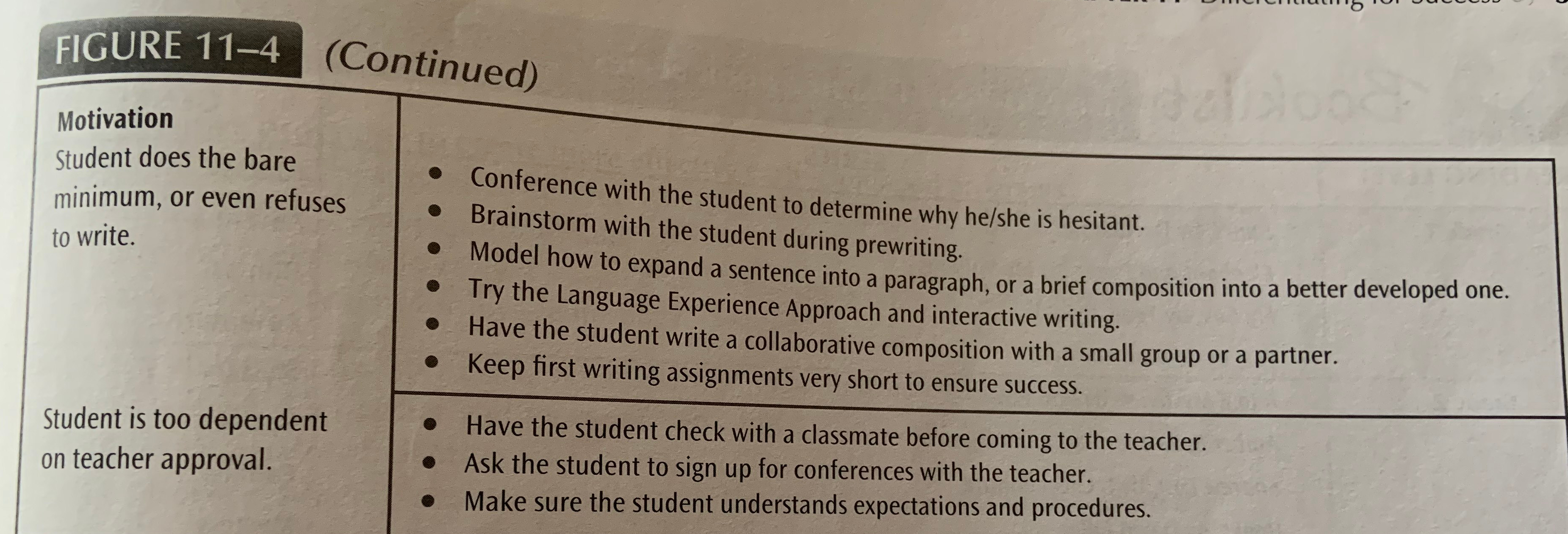
How to Address Struggling Writers Problems-

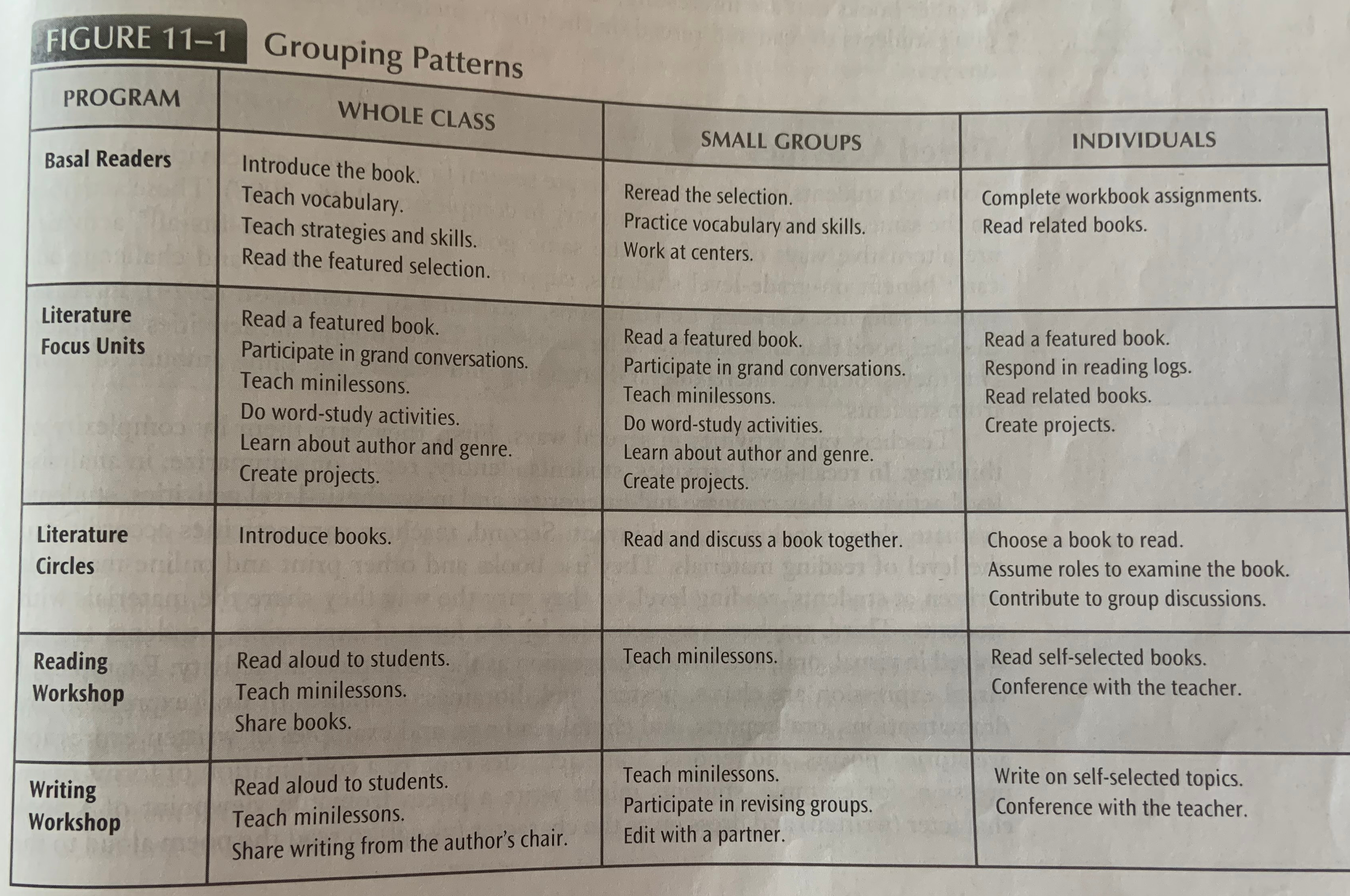
Grouping for Instruction-

Tiered Activities- Activities that focus on the same essential knowledge but vary in complexity. Might include recall level activities, reading material level, or activities that allow expression or a combination of the different forms. Tiered activities allow for all students to try and be successful.

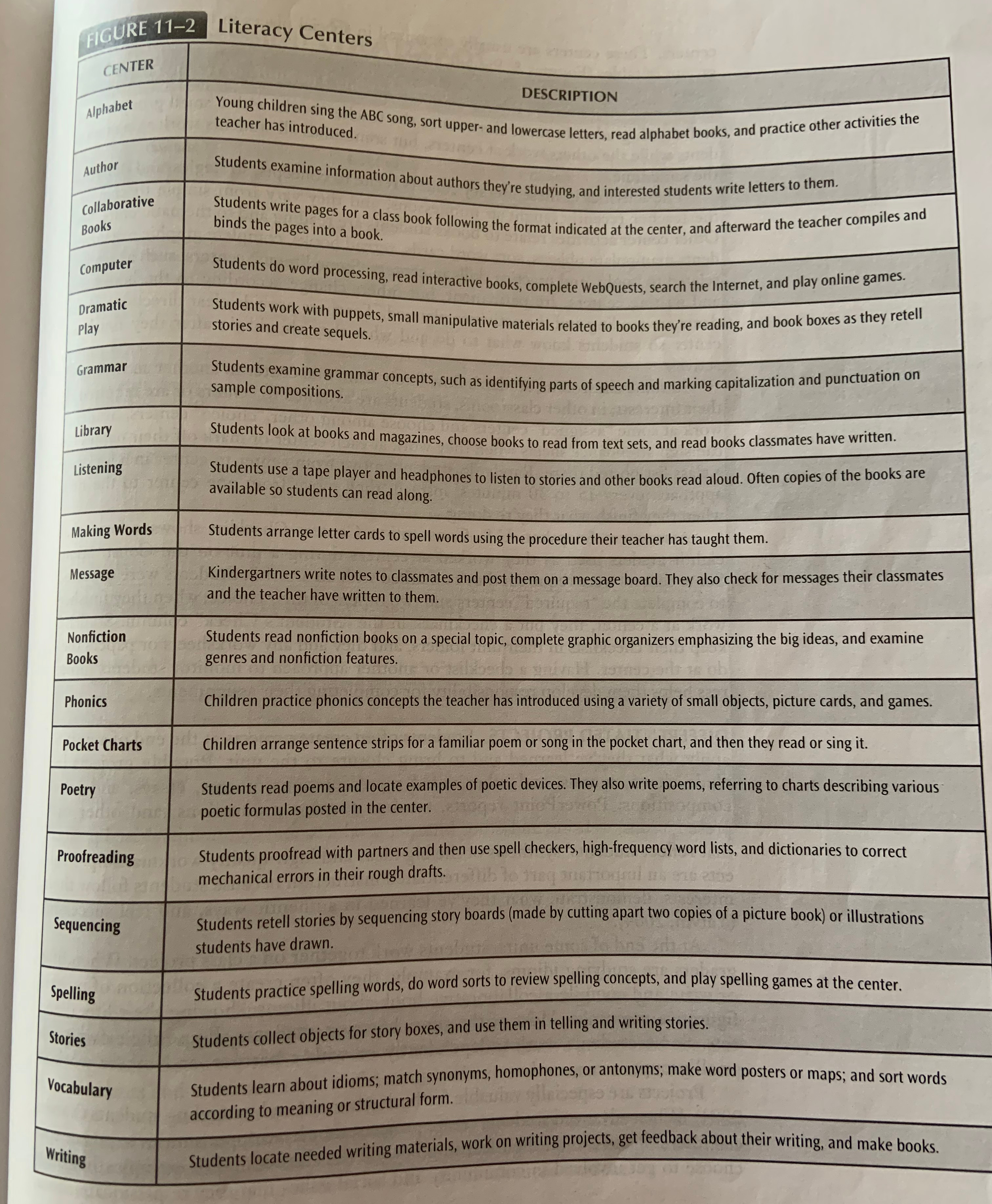
Literacy Centers-

Interventions- Are intense, individualized instruction for struggling readers/writers to solve reading/writing problems and accelerate their growth.

Response to Intervention (RTI)- School wide initiative to identify struggling students quickly, promote high-quality classroom instruction, provide effective interventions and increase likelihood that students will be successful. Three Tiers include: Tier 1 Screening and Prevention, Tier 2 Early Intervention and Tier 3 Intensive Intervention.

Intervention for Older Students- Three components of intervention program include: High Quality Instruction- appropriate literacy instruction tailored to student needs and instructional time is spent on vocabulary and comprehension. Instructional-Level Reading Materials- Teachers use books at students instructional level that are also appropriate for their age. More time for Reading- Teachers increase the amount of time students are suppose to read independent books.

Application to Classroom- I will show responsibility and commitment to teaching all students by personalizing their instruction by modifying content, the process, and product for both struggling and non-struggling students. I will also make sure to allow extra time for reading and writing with a balanced approach for all students.

Amanda Jachthuber, EngEd 275, Ch. 10 Organizing For Instruction

Key Vocab and Concepts:

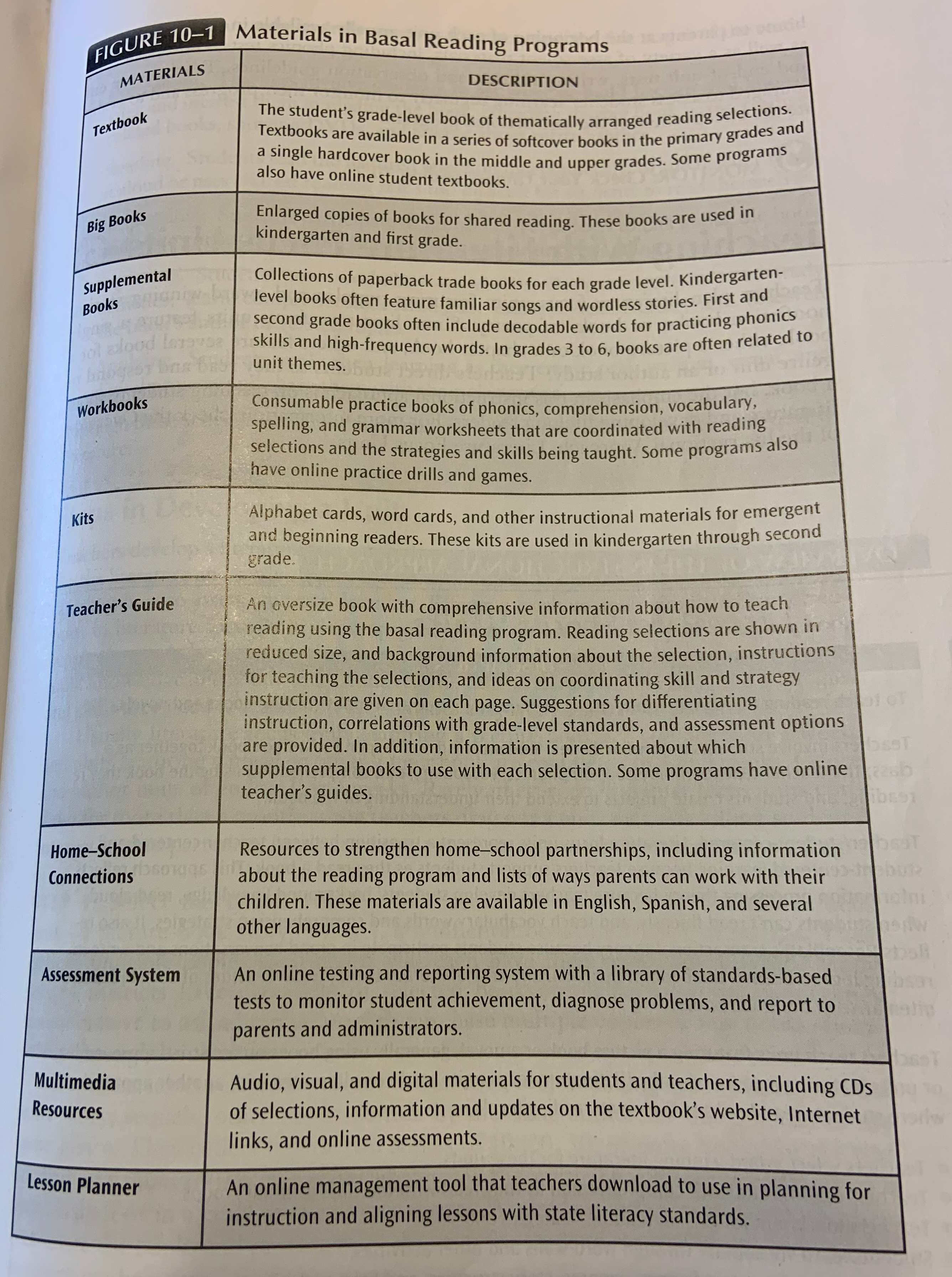
Basal- short stories that include individual books for students, a teacher edition, workbooks, assessments and activities for a specific reading level.

Components of Basal- There are five components that consist of reading selections in the grade-level textbook, instruction on strategies and skills, workbook assignments, independent reading opportunities and a management plan that includes flexible grouping and regular assessment.

Materials in basal reading programs-

Literature Focus Units- Teach reading through literature, using high-quality, grade-appropriate picture books and novels. The units include activities incorporating the five stages of the reading process which include pre-reading, reading responding, exploring, and applying.

Steps in developing a literature focus unit- Step 1: Select the literature, Step 2: Set Goals, Step 3: Develop a unit plan, Step 4: Coordinate grouping patterns with activities, Step 5: Create a time schedule and Step 6: Assess Students

Literature Circles- An instructional approach in which students meet in small groups to read and respond to a book.

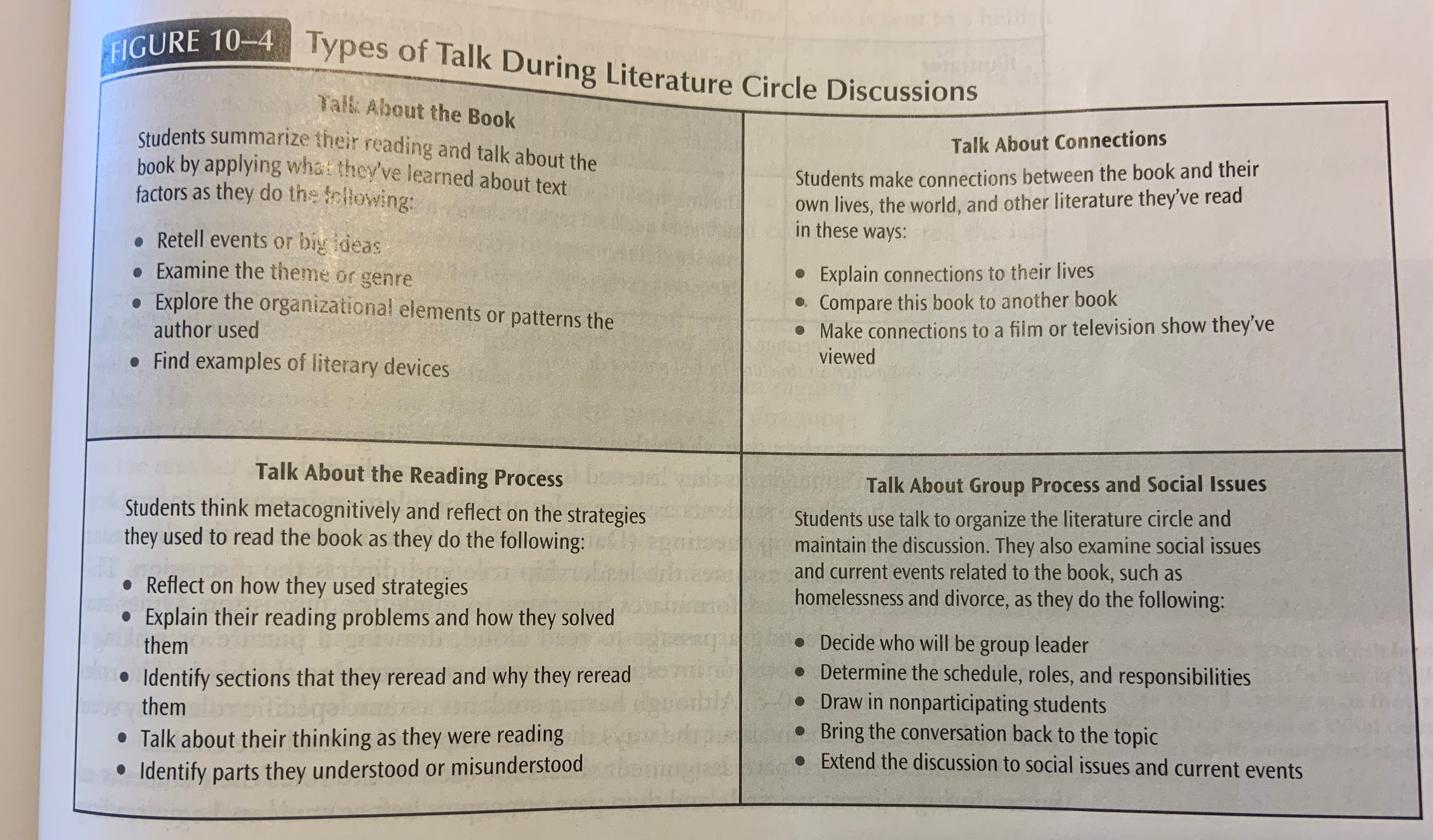
Key Features of a Literature Circle- Choice: students choose books the books and groups in which they will participate in. They share in setting a schedule for reading, discussing and roles that will be assumed in the discussions. Literature: should be at students reading level and manageable. Response: students meet several times to discuss the book. Through the discussions students summarize, make connections, learn vocabulary, and explore the authors use of text factors.

Types of Talk During a Literature Circle-

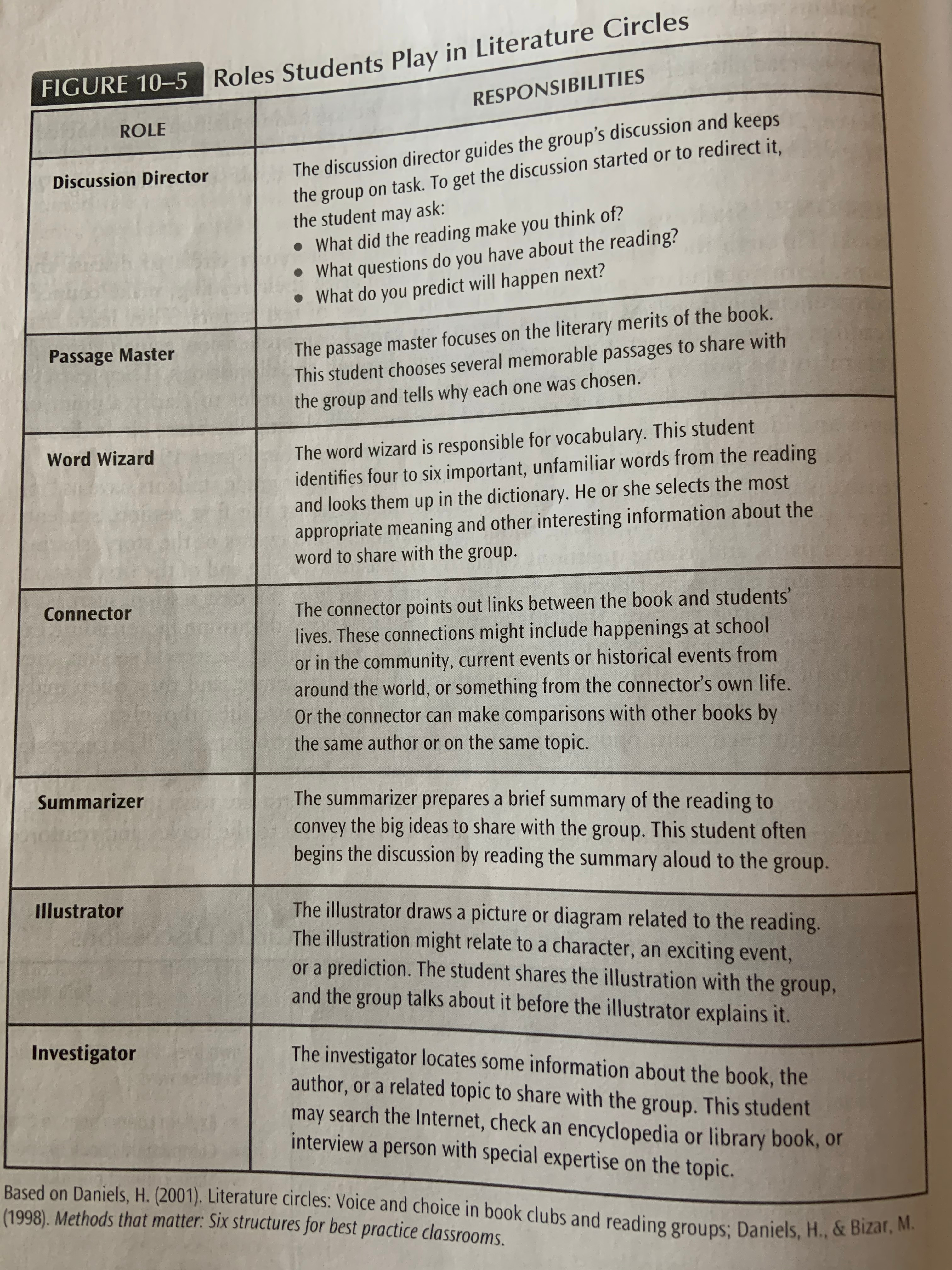
Roles Students Play in Literature Circles-

Reading Workshop- An individualized reading program where students read books that they choose and respond to books through writing in reading logs and conferencing with both teachers and classmates.

Writing Workshop- Students write on topics that they choose and assume ownership of their writing and learning. The teachers role changes from being the provider of knowledge to serving as a facilitator and guide.

Think-Alouds- A procedure in which teachers or students verbalize their thoughts while reading or writing to describe their strategy use.

Grand Conversations- lively talks about a book. Teacher initiates the conversation with a questions or interpretive prompt.

Goldilock Strategy- A strategy for choosing “just right” books

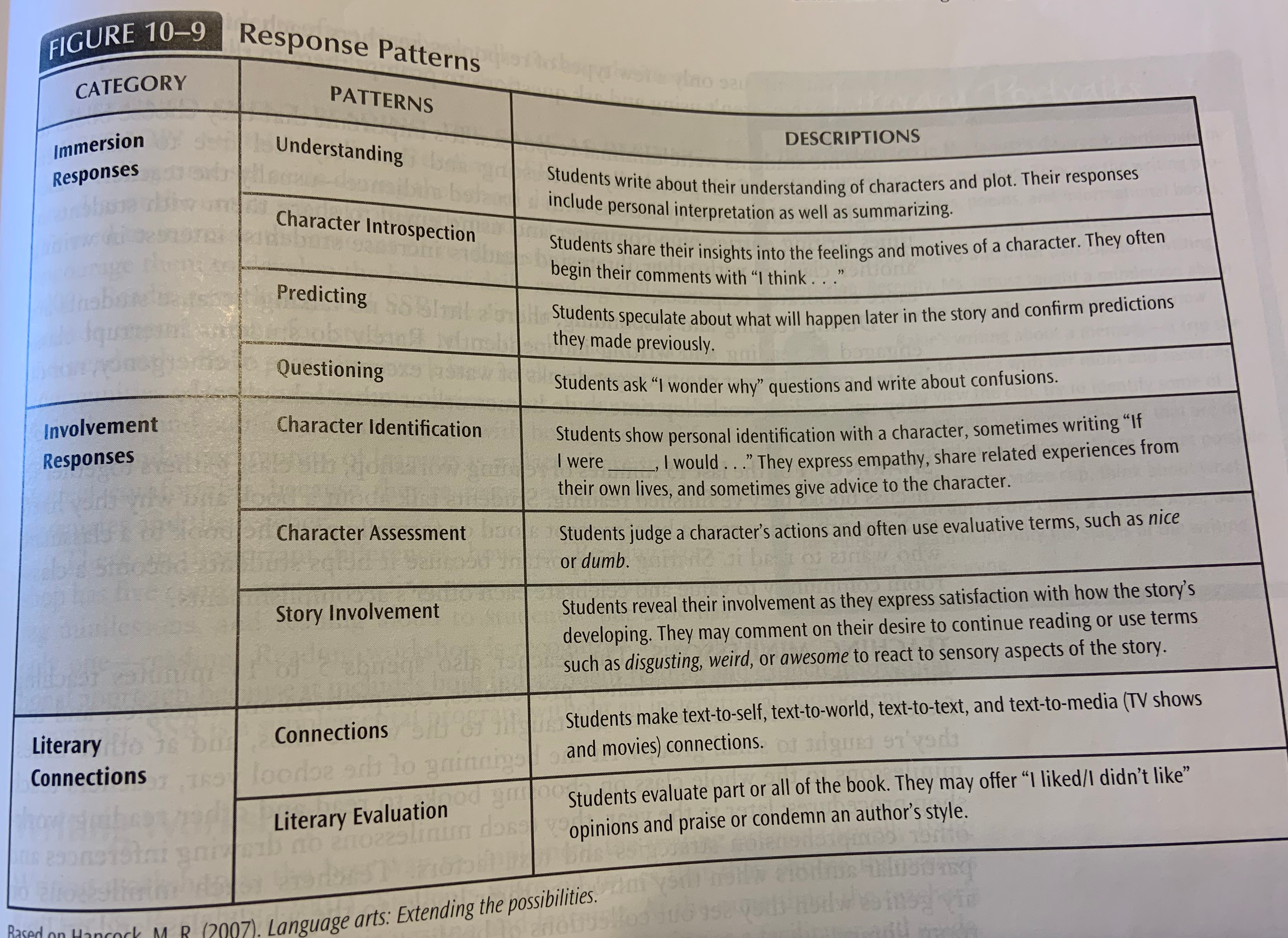
Responses in Reading Workshop-

Sustained Silent Reading (SSR)- An independent reading time set aside during the school day for students in one class or even the entire school to silently read self-selected books. It is used to increase the amount of reading students do and encourage them to develop a daily reading habit.

Management of the Workshops- Begins the first day of school and throughout the year provide students time to read and write and how to respond to books and to others writing. A schedule is made, charts are used, and students are observed.

Classroom Application- Organization for instruction is done using a combination of approaches to ensure students can read grade-level books and meet both the reading and writing standards. Teachers use leveled books to teach reading in a guided reading lesson. Teachers supplement basal reading programs with authentic reading and writing activities. Students are presented with literature focused units and teachers incorporate choice, literature and response into literature circles.

Video-Teaching Strategies For Introducing Literature Circles to a 4th Grade Class- Take time at the beginning of the year to teach and model the do’s and don’ts. In circle the students will communicate, create, critically think and collaborate. Day 1: introduce book, the group roles and explain expectations. Day 2-3: review group roles, students will independently read and work while the teacher holds a small group. Day 4: review of expectations and student literature discussions. After the discussion new roles will be given and a new book.

Amanda Jachthuber, EngEd 275, Ch. 9 Promoting Comprehension: Text Factors

Key Vocabulary and Concepts:

Genre – A category of literature such as folklore, science fiction, biography, or historical fiction, or a writing form.

Text Structures – Organizational patterns or genres.

Text Features – Literary devices and display conventions that authors use to achieve particular effects in their writing, such as point of view, metaphors, rhyme, and headings.

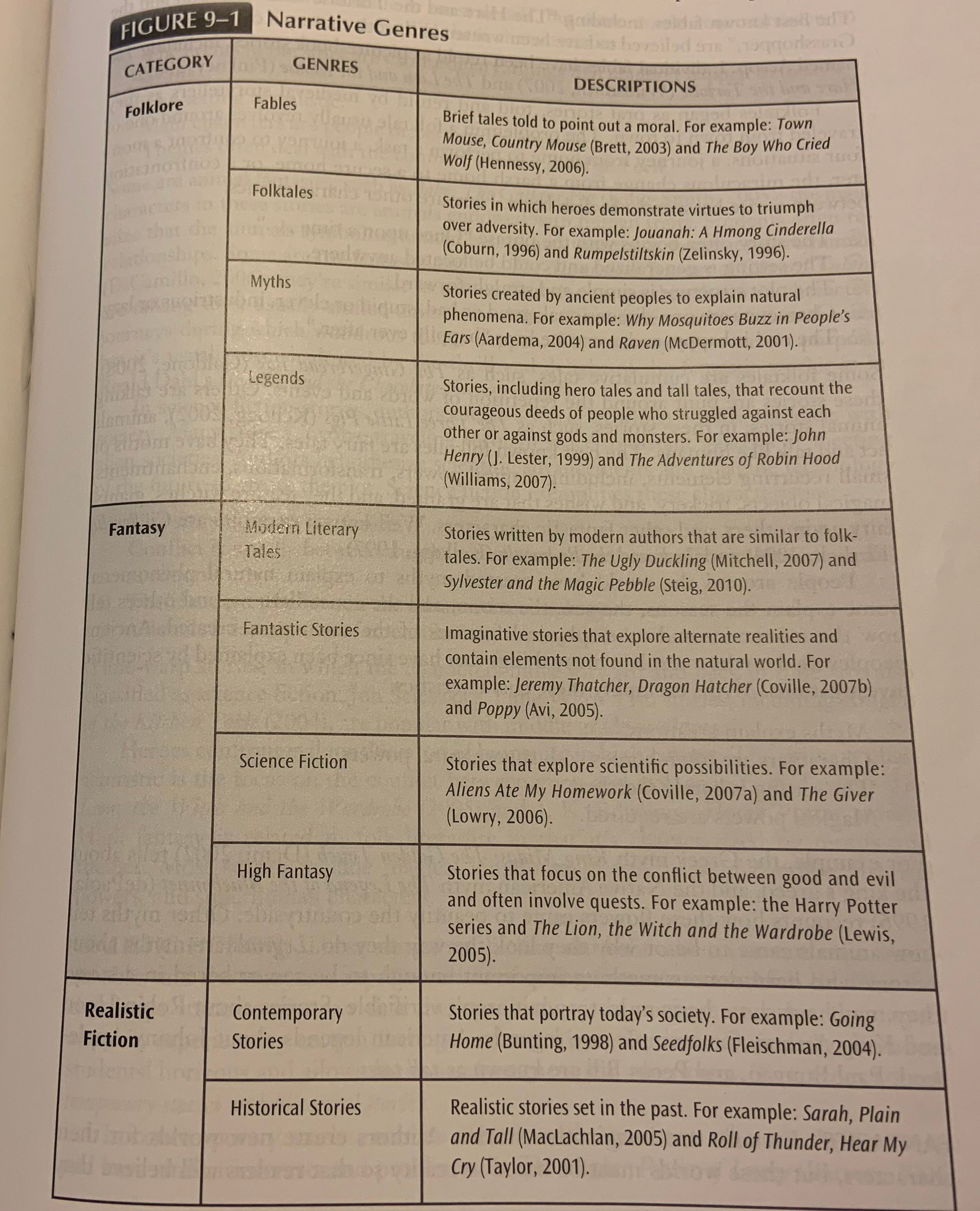
Narrative Genres –

Elements of a Story Structure: Plot – The events that make up a story. Characters- the people or personified animals in the story. Setting (Has four demensions)- location, or a predicatable setting the contributes to the effectiveness of the story. weather, which is essential to the plot development of the story. time period, where the story is set to take place like in the past or future. time, involves both time of day and passage of time. Point of View (Has four viewpoints): First person viewpoint, tells the story through the eyes of one character using hte first-person pronoun I. Omniscient Viewpoint, author is godlike, seeing and knowing all, telling readers about the thought process of each character without worrying about how information is obtained. Limited Omniscient Viewpoint, told in third person where the author concentrates on thoughts, feelings and experiences of the main character. Objective Viewpoint, readers are eyewitnesses to the story and are confined to the immediate scene, they learn only what is visible and audible and are not aware of character feelings. Theme-underlying meaning of the story

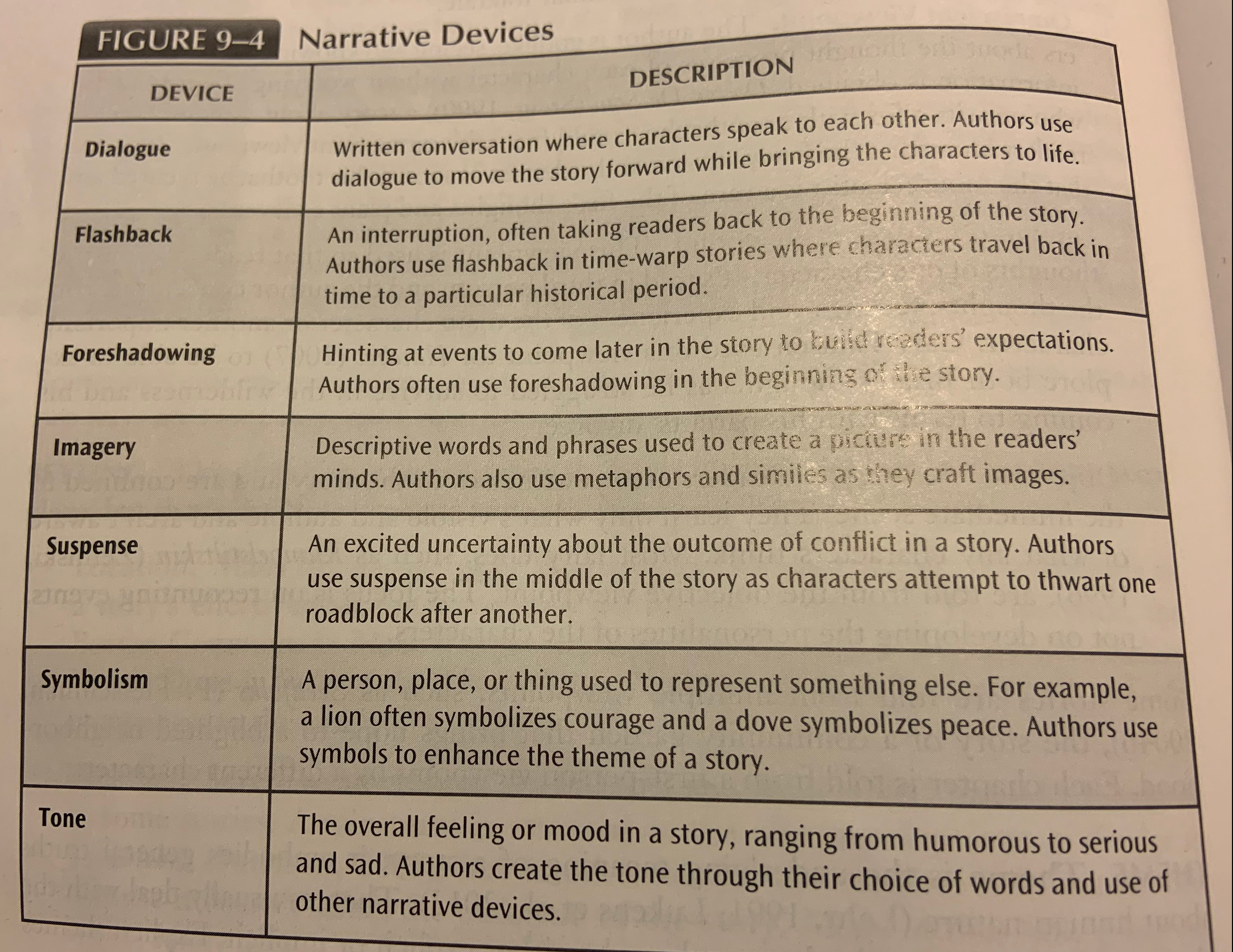
Narrative Devices-

Text Factors of Nonfiction Books- Include things such as headings and subheadings to direct readers attention to the big idea, use of photos and drawings to help illustrate the big idea and they sometimes have figure, maps, and tables to provide diagrams and detailed information visually.

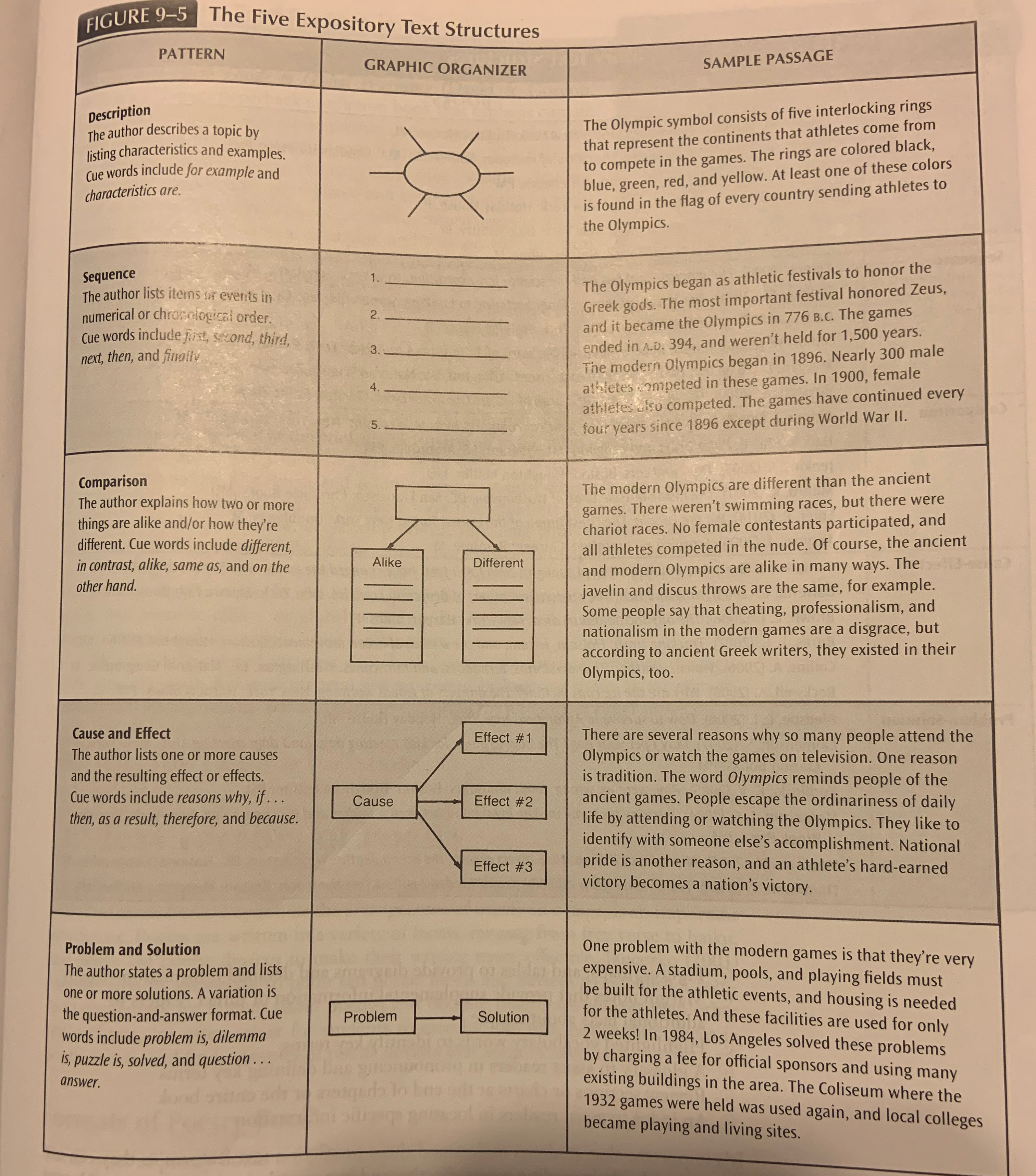
Expository Text Structures- Are organized into five expository text structures that include description, sequence, comparison, cause and effect and problem and solution.

Text Factors of Poetry- The layout or arrangement of words on a page, is important text factor. Poems are written in a variety of ways ranging from free verse to haiku. Poems are shorter than other types of text making it easier for students to examine.

Formats of Poetry- There are three types of poetry books they include picture-books, specialized collections of poems, and comprehensive anthologies.

Poetic Forms: Ryhmed Verse– has rhyming vowel sounds at particular moments. Narrative Poem- a metered poem that tells a story with clear objectives. Haiku- Japanese poetic form that contains 17 syllables arranged in three lines of 5-7-5 syllables. Odes- celebrate everyday objects. Unrhymed and written directly to a specific object and tells what is good about the object and why it is valued. Concrete poems- visual poetry where the typographical effect is more important in conveying meaning than verbal significance. Free Verse– poetry that is free from limitations of regular meter or rhythm and does not rhyme with fixed forms.

Assessing Text Factors: Planning- text factors are determined and how they will monitor student progress is determined. Monitoring- Student progress is observed through conferencing about their reading and writing. Notes of students understanding is recorded on a log. Evaluating- Students are encouraged to apply their knowledge of genres, structural elements and literary devices done using rubrics or checklists. Reflecting- students are asked to think about how they are growing in their ability to use text factors to comprehend complex texts. Teachers also think about their own effectivness.

Application to Classroom- Students are taught to use knowledge of genres, structural elements, and literary devices to help increase comphrension of complex texts. Students are taught that stories have unique text factors; narrative genres, story elements and narrative devices. Students are taught that nonfiction books have unique text factors: nonfiction genres, expository text structures, and nonfictions features. Students are taught that poems have unique text features: book formats, poetic forms and poetic devices. Students are taught about text factors and the role they play in comprehension.

Videos:

Myths, Fables and Folktales – Myth, a short story that explains why something is the way it is. It usually teach a lesson and involves magic. Fables, are short stories used to teach a moral or lesson and animals are often the main character. Folktales, are short stories that have been told orally from one generation to the next.

The Grasshopper and the Ants- A fable where the moral of the story is that you work today for what you will need tomorrow.

Fiction Book Genres: What is a Fantasy- Fantasy is imaginary, make believe or pretend and comes from visions or dreams and contains unreal things or characters.

Fiction Book Genres: What is Science Fiction- Contains unreal things that could be real in our world in the future. Explores when things go wrong with tools or advancements and takes place in real world or a world with similiar rules.

Realistic Fiction- Are stories that could happen in real life. The characters are human and the setting takes place in the world as we know it. A story that seems true but comes from the authors imagination.

NonFiction Text Features- Help you make sense of what your reading and what information will be most helpful to the reader.

Story time with Berly: My Parents Think I’m Sleeping- This is a poetry book where the main character reads under his covers at night as he watches shadows dance on his wall.

Amanda Jachthuber, EngEd 275, Ch. 8 Promoting Comprehension: Reader Factors

Key Vocab and Concepts:

Comprehension- The process of construction meaning using both the author’s text and the readers background knowledge for a specific purpose.

Text Complexity- a way to determine the comprehension demands of a book or other text using reader and text factors.

What Readers think about when reading- Readers activate prior knowledge, examine the text to uncover the organization of it, make predictions, connect to their own experiences, create a mental image, draw inferences, notice symbols and other literacy devices, and monitor their understanding.

Comprehension factors and their roles- Background knowledge: students activate their world and literary knowledge to link what they know to what they are reading. Vocabulary: students recognize the meaning of familiar words and apply word-learning strategies to understand what they are reading. Fluency: students have adequate cognitive resources available to understand what they are reading when they read fluently.

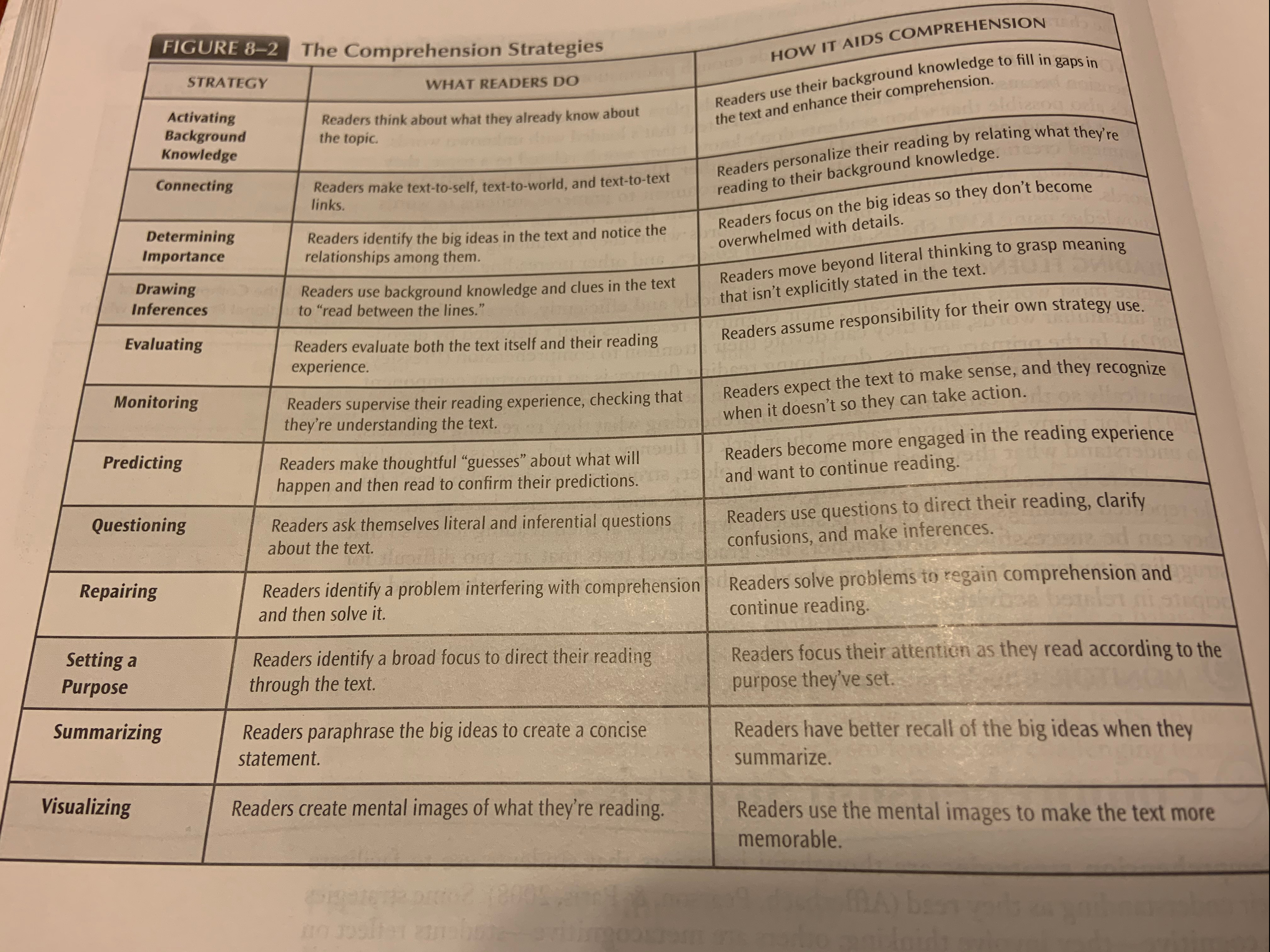
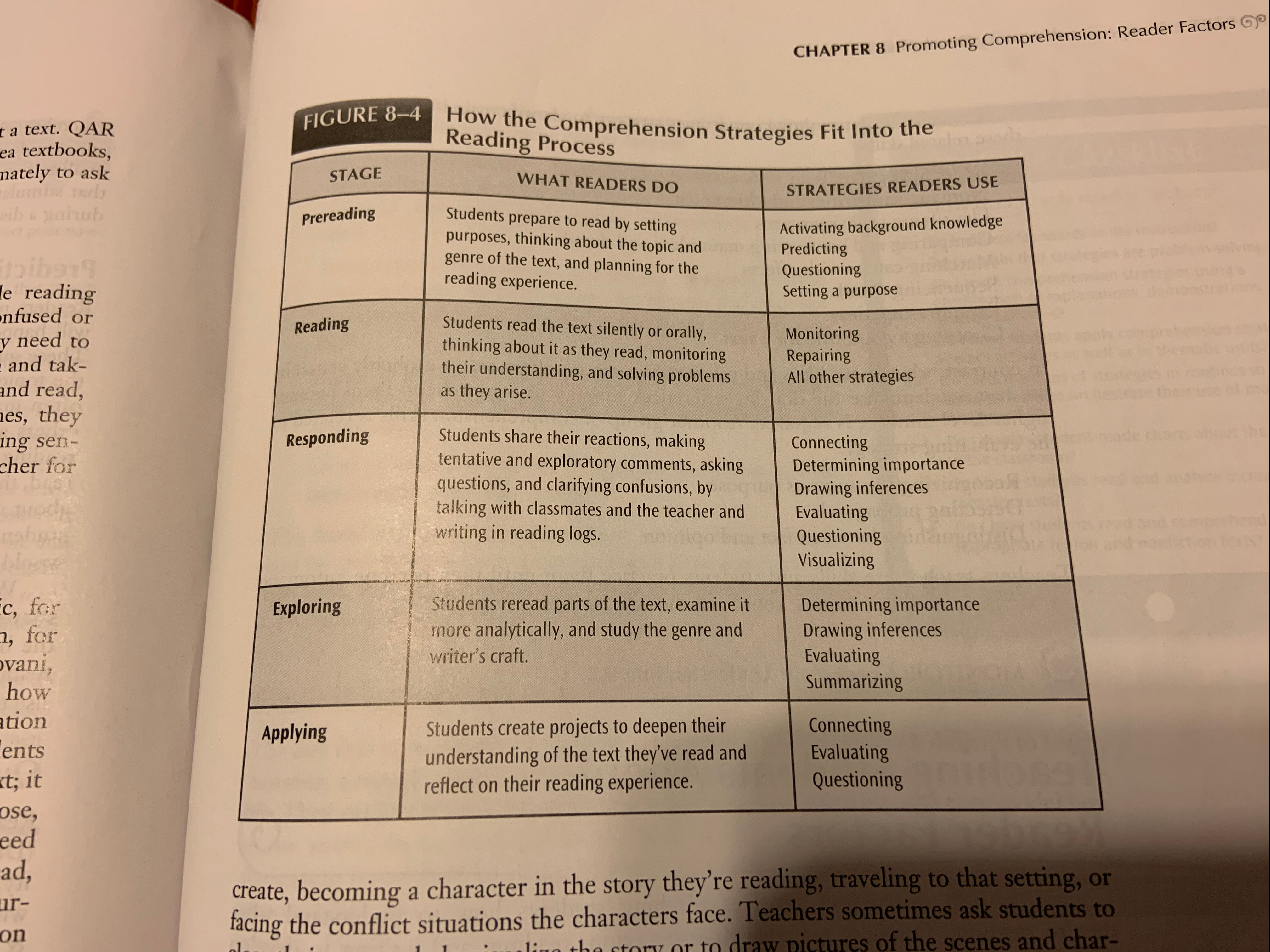
Comprehension Strategies and what readers do- Comprehension strategies are thoughtful behaviors that students use to facilitate their understanding as they read. Some are cognitive where they involve thinking and others are metacognitive where the student reflects on their thinking. (the picture show all the strategies and what readers do)

How to create an expectation of comprehension- Involve the students in authentic reading activities, provide access to a well stocked classroom library, teach students to use comprehension strategies, ensure that students are fluent readers, provide opportunities for students to talk about the books they are reading, and link vocabulary instruction to underlying concepts.

How the Comprehension strategies fit into the reading process-

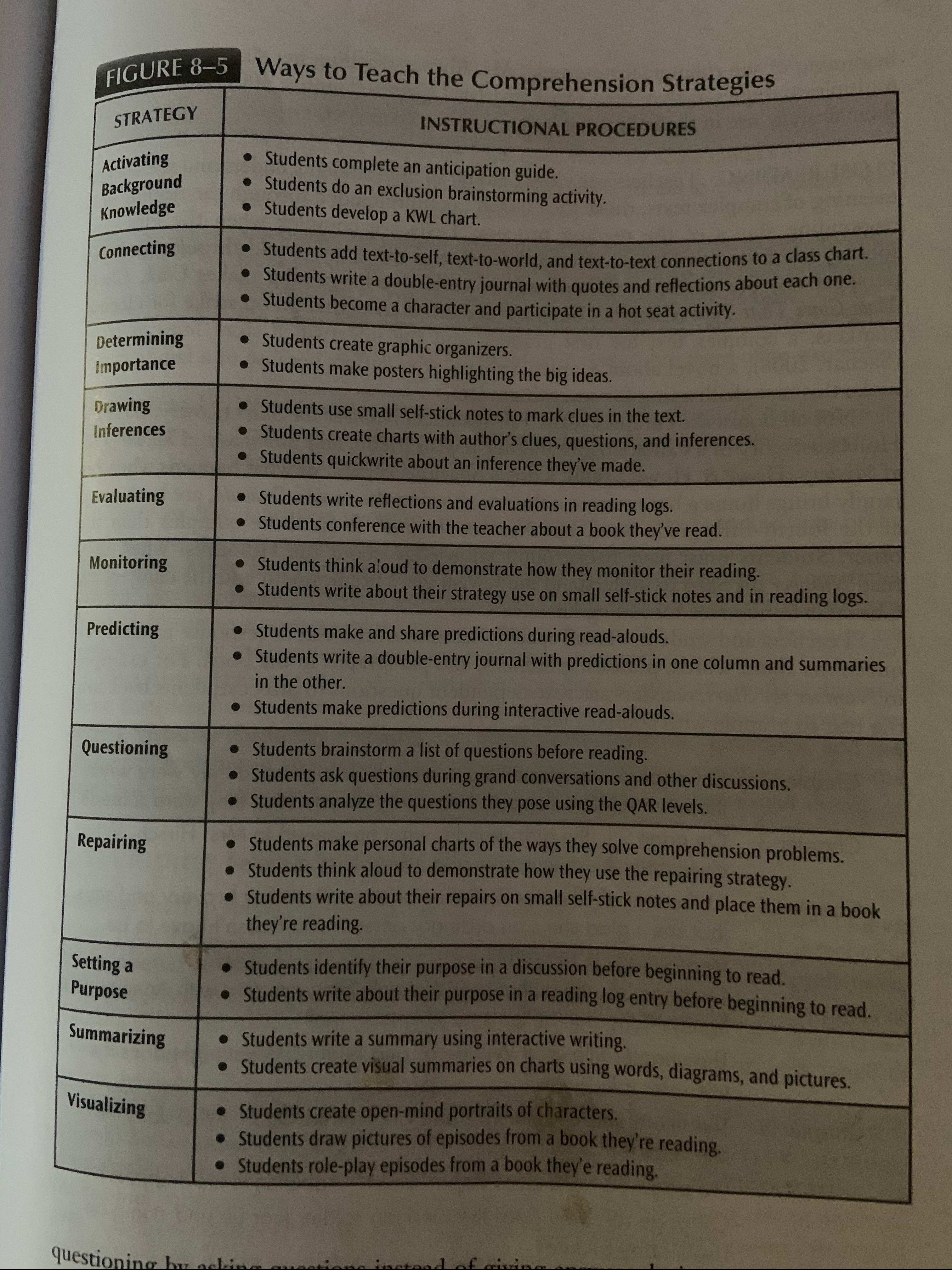
Ways to teach comprehension-

Assessing comprehension- Cloze Procedure: teachers examine students understanding of a text using the cloze procedure where students supply the deleted words in a passage taken from a text they have read. Story retellings: where a teacher has a student retell a story they have read or listened to, to assess literal comprehension. The story telling should be coherent and well organized and should include big ideas and important details.

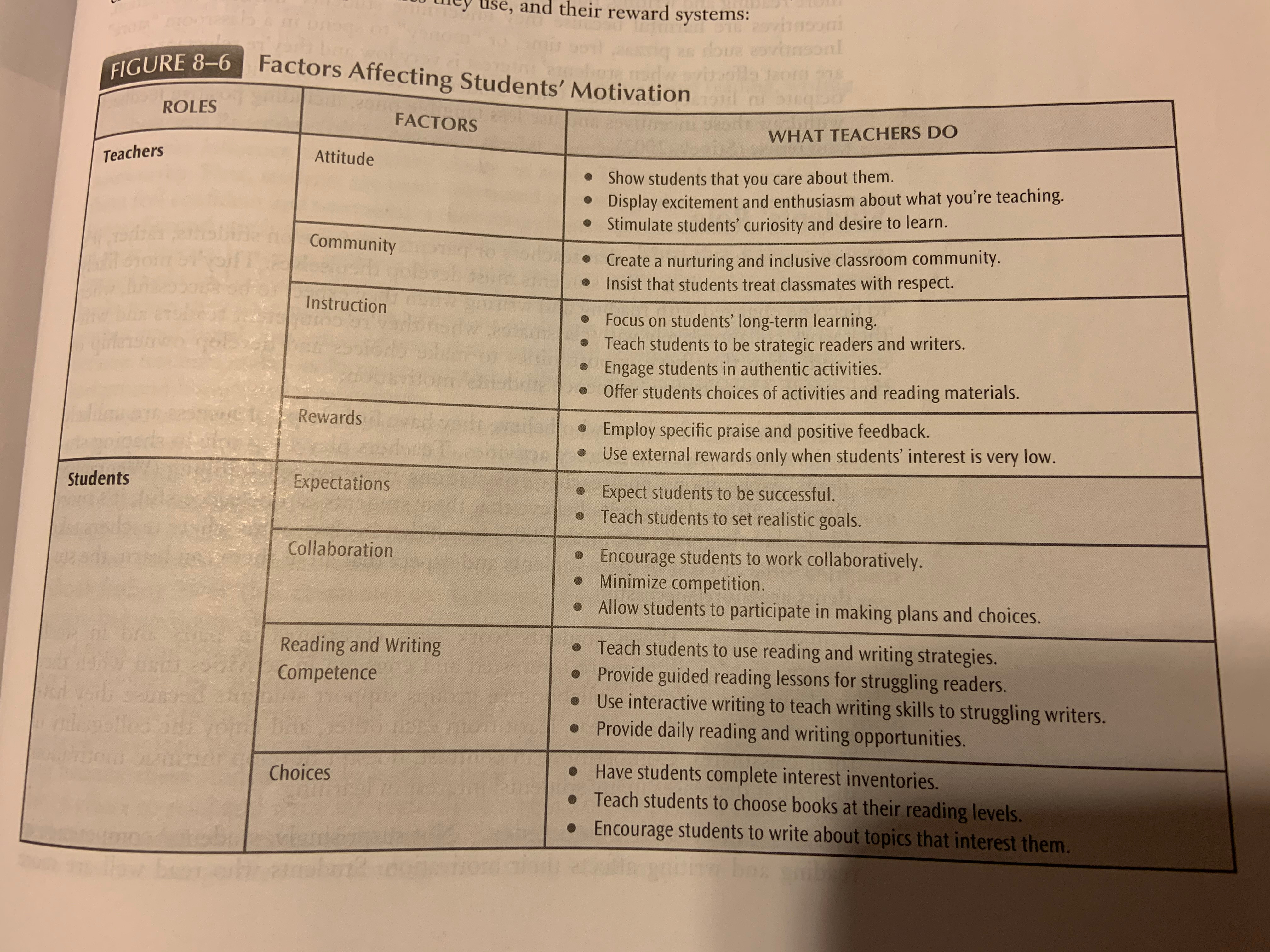
Factors affecting students motivation-

Application to classroom- Effective teachers demonstrate their responsibility and commitment to faciliatating their students comprehension when they emphasize that comprehension is a process involving both reader factors and text factors. Students use comprehension strategies to direct their reaading and monitor their understanding and teachers teach the students how to apply the comprehension strategies to support what it is they student is understanding in the text. Students movtivation is nurtured through a variety of literacy activites to help keep them engaged.

Works Cited:

Tompkins, G. E. (2017). Literacy for the 21st century: a balanced approach. Boston: Pearson.

Amanda Jachthuber, EngEd 275, Ch. 7 – Expanding Academic Vocabulary

Key Concepts and Vocab:

Academic Vocabulary – frequently used words in social studies, math, science and language arts.

Three Tiers of Words: Tier 1: Basic Words- words used in a socially informal conversation at home or on playground. Tier 2: Academic Vocabulary- words that are more frequently written rather than spoken, they have a wide application in the school setting. Tier 3: Specialized Terms – content specific and are often abstract. Not used frequently to devote time teaching them.

Levels of Word Knowledge: Unknown word- words that are not recognized. Inital Recognition – words that have been seen, heard or even pronounced but the meaning is unknown. Partial Word Knowledge – one meaning of the word is known and it can be used in a sentence. Full Word Knowledge – more than one meaning is known and it can be used in several ways.

Word Consciousness – students interest in and awareness of words and their meanings.

Multiple Meanings of Words- Many words have more than one meaning. Multiple meanings for some words develop for the noun and verb forms. Other times the meaning develops through word play and figurative language. Additional meanings are acquired through reading.

Synonyms- words that mean nearly the same thing.

Antonyms- words with opposite meanings.

Homonyms- Words that sound alike but are spelled differently.

Root Words – Have no prefix or suffix. Root words are free morphemes or words that can stand alone as a word.

Affixes- syllables added to the beginning or end of a word to change the meaning.

Etymologies- is the history of words or the orgin of certain words.

Word Study Activities- Activites used for students to examine new words and think more deeply about them as they participate in the activity. Teachers use the activities to teach new academic vocabulary such as word posters, word maps or word chains.

Word-Learning Strategies- there are a variety of things a student can do when coming across an unfamiliar word that includes using context clues, analyzing word parts and checking the dictionary. When trying to figure out the meaning of a word students should reread the sentence containing the word, use context clues to figure out meaning, and examine word parts while looking for familiar root words and affixes to help aid in finding the meaning. If that does not help students should pronounce the word to see if they recognize it and if that dont help they should use the dictionary or ask for help from the teacher.

Application to Classroom: Teachers can catergorize unfamiliar words into three tiers which include basic words, academic vocabulary and specialized terms. The following vocabulary concepts will be taught: multiple meanings, synonyms, antonyms, homonyms, root words and affixes, etymologies and figurative language. Teachers will be able to teach academic vocabulary and word -learning strategies through a variety of activities. These things demonstrate responsibility and commitment to ensuring students are successful when it comes to vocabulary use.

Works Cited:

Tompkins, G. E. (2017). Literacy for the 21st century: a balanced approach. Boston: Pearson.

Amanda Jachthuber, EngEd 275, Ch. 6-Developing Fluent Readers and Writers

Key Vocab and Concepts:

Reading Fluency- the ablitiy to read quickly, accurately and with expression. In order to read fluently, students must recognize most words automatically and be able to identify unfamiliar words easily.

automaticity- the ability to quickly recognize words. This is done through repeated reading and writing experiences.

speed- how many words a student can read per minute. fluent readers should be able to read at least 100 words per minute although their speed may vary depending on topic, genre and text complexity.

prosody- a concept that fluent readers read sentences expressively with appropriate phrasing and intonation. There are five components of prosody that include; expression, phrasing, volume, smoothness and pacing.

high frequency words- common words used over and over again by readers.

word identification strategies- strategies used to decode unfamiliar words: phonic analysis- students notice all letters in a word and analyze the letter sequence. decoding by analogy- students identify words by associating them with words they already know. syllabic analysis- more experienced readers use this to divide longer words. morphemic analysis- used to identify mulitsyllabic words.

assessing reading fluency- teachers will informally monitor students by listening to them read aloud. they also check students knowledge of hig-frequency words and how they use word-identification strategies to decode words, while checking for speed. Teachers may use rubrics or running records to help make instructional decisions.

writers voice- distinctive voices that reflect individuality. voice is the tone or emotional feeling of a piece of writing. writers develop their voice by the words they choose and how they are used within a sentence.

dysfluent readers and writers- can not recognize high frequency words, guess words by beginning sound, they point to words as they read, they read to slowly or quickly, they misspell many words even the high frequency ones, they write slowly and illegibly, they do not use punctuation marks and they write very little.

obstacles to fluency- obstacle 1: lack of automaticity- explicit instruction to read and write high-frequency words. obstacle 2: unfamiliarity with word-identification strategies- teachers introduce new vocab wordes before reading, teach identification strategies and give more time for reading/writing practice. This is to help dysfluent readers and writers develop automaticity. obstactle 3: slow reading speed- teachers provide daily practice to develop reading speed and stamina through repeated readings. obstacle 4: slow writing speed- quickwriting, reading logs, simulated journals and learning logs will help to improve a students writing speed. obstacle 5: lack of prosody- teachers emphasize prosody by modeling expressive reading every time they read a book. obstacle 6: voiceless writing- when students do lots of reading and writing then their writers voice develops.

Application to the classroom: Teachers ensure students are fluent readers and writers by developing three components of reading fluency: auomaticity, speed and prosody. Teachers work with dysfluent students to overcome obstacles by providing explicit instruction, increasing time for reading, modeling what fluent reading and writing looks like, and clarifying connections between reading fluency and comprehension.

Amanda Jachthuber, EngEd 275, Ch.4 The Youngest Readers and Writers and Blooms Taxonomy

Vocab and Concepts:

Shared Reading: Teachers read big books and or poems written on charts, an activity that leads or serves as a lead in to the minilesson.

interactive reading: a read aloud where children both listen and engage in talking about the text

choral reading: students read a passage together. helps build fluency

guided reading: teacher works with small group of students whom are all at the same level with similiar reading behaviors. focuses on childs specific need

word wall: has high frequency words; is divided into sections for each letter of the alphabet; new words are introduced weekly; students use it as a resource to help spell words when writing.

mini lessons: used to teach literacy procedures, concepts, strategies, and skills.

interactive read-aloud-

Concepts of Print: the purposes of written language are demonstrated and provided through signs being posted in the classroom, making a list of classroom expectations, labeling classroom items, drawing and writing in journals, use of reading/writing materials in play centers, and reading and writing stories.

Concepts about words: concepts of words are developed through active participation such as watching teachers point to words, or by pointing to words in familiar texts.

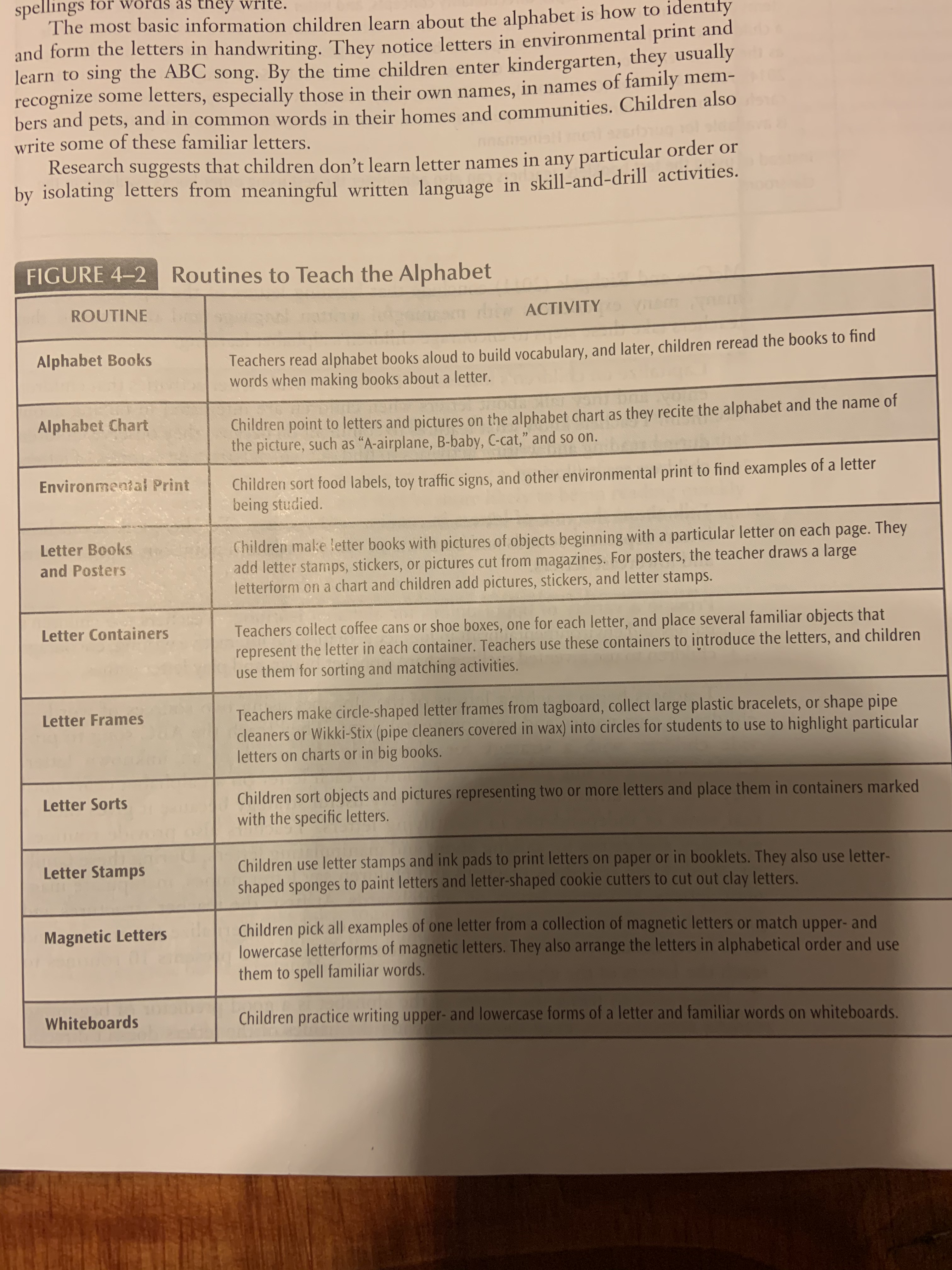
Concepts about the alphabet: the most basic information learned about the alphabet is how to identify and form the letter in handwriting. Concepts are developed through a variety of components used to decode unfamiliar words.

Routines to teach the alphabet: undefined

Environmental Print: signs, labels and other print found within the community

assessing concepts of written language: teachers observe and monitor children when looking at books or when writing to understand concepts being understood.

emergent reading and writing stage: in this stage children accomplish and interest in reading, acquire concepts about print, develop book handling skills, identify letters, develop handwriting skills and learn to read and write high-frequency words.

beginning reading and writing stage: marks the students growing awareness of alphabetic principle. They learn about phoneme-grapheme correspondences, phonics, word families and apply and misapply their developing phonics knowledge to spell words.

fluent reading and writing stage: in this stage students accomplish fluently reading with expression, recognize one syllable words, use decoding and comprehension strategies, spell most high-frequency word, and use capital letters and punctuation marks correctly.

morning message: daily literacy routine used to teach literacy concepts, strategies and skills. Brief message about what the day will look like.

predictable books: books that have repeated sentences, rhyme or other patterns.

language experience approach: teachers use shared writing where student dictates words or sentences about their experiences and the teacher writes it down.

interactive writing: text is created together by both student and teacher. Children compose a message and then teacher guides them as they write it word for word on the chart.

manuscript writing: focuses on holding a writing utensil the correct way and focusing on letter formation. Teachers model for students and then watch students

Blooms Taxonomy: six levels: knowledge/remembering- student recalls and or recognizes information or ideas in the approximate form in which they were learned. comprehension/understanding- student translates information based on prior learning. application/applying- student selects and uses data to complete a problem with minimum direction. analysis/analyzing- student can distinguish and relate assumptions, evidence or structure of a statement or question. synthesis/evaluating- student originates and combines ideas into a product, plan or proposal that is new to him/her. evaluation- student appraises or critiques on basis of specific standards and criteria.

Application to the classroom: This chapter has helped me to better understand how to nurture a students oral language development and foster their interest in literacy. Furthermore it gave me understanding on how to match instructional activities to the students stage of reading and writing development.

Amanda Jachthuber, EngEd 275, Ch. 3 Assessing Literacy Development

Key Vocabulary and Concepts:

Running Records- an assessment tool used to show how a student reads using their regular reading materials while the teacher makes a detailed account of their ability to read

Minilessons- a lesson with a more narrow approach that give instruction to a concept that the student will relate to a larger lesson that follows the minilesson.

Book Talk- Where a student shares with the rest of the class specific information about the book they read such as the title and author’s name, sharing an excerpt from the book or sharing information such as characters and or the plot. They summarize the book but don’t give away the ending.

4 Steps of assessment- Step 1: Planning for Assessment- Teachers think about questions such as ‘have students learned the concepts that have been taught?’ before planning a lesson so they are better prepared to use the assessment tools. Step 2: Monitoring Students’ Progress- This allows for teachers to learn about the students and their individual strengths and weaknesses and their instruction. They do this through observations, anecdotal notes, conferencing, and making checklists. Step 3: Evaluating Students’ Learning- assessment at this stage is summative and documentation is used to make judgements about student achievement. Step 4: Reflecting on Students’ Learning- This is the stage where the teacher reflects on themselves to help improve their own effectiveness to adapt thier instruction to meet the needs of all students. They also analyze students achievement at this stage.

Anecdotal Notes- notes that describe specific events that relate the event to the student. They include questions students had and the skills they use and or don’t use.

Rubrics- are scoring guides that how the student is doing according to a certain criteria and level of achievement.

Portfolios- Include include samples of students work such as adio files, lists of books that have been read, reading logs, photos of projects etc.

Instructional Reading Level- books are read at the students level but not read alone. Reading is not always fluent at this level. Comprehension is understood by support from either teacher and or classmates.

Frustration Reading Level- Even with assistance books at this level are too difficult for a student to complete successfully. Reading is choppy and read word by word and most of the time does not make sense. Little comprehension is shown of what has been read.

Independent Reading Level- books are read by the student on their own comfortably. The reading is fluent and they comprehend what they have read.

Guided Reading- an instructional approach where teachers work in small groups where all students are at similiar reading levels and behaviors of reading.

Leveled books- Fountas and Pinnell is used to identify students level based on grade level. Based on a variety of variables that influence reading difficulty.

Lexile Framework- This identifies both the students reading level and difficulty level of the book. The wide range of scores allows teachers to better match students and books.

Informal reading inventories- used to evaluate a students reading performance. Used to determine if a student is reading at grade level and or to identify a struggling students instructional needs in areas of word identification, oral fluency and their comprehension. Consists of two parts, word lists and passages.

Miscue analysis- procedure for categorizing and analyzing a students oral reading errors.

SOLOM (Student Oral Language Observation Matrix)- a rating scale used to assess a students command of English while they are talking and listening in everyday activities. Addresses five components of oral language: listening– scored from able to comprehend a simple sentence to understanding conversations, fluency– scored from frament to fluent speech, vocabulary– scored from limited word knowledge to using words skillfully, pronunciation– scored from unintelligible speech to pronunciation proficiency, and grammer– scored from excessive errors that make speech unitelligible to being able to apply word order and usage rules the right way. Each of the components has a five point range.

K-W-L Charts- an organizer used to organize information before, during and after a lesson. Helps teachers monitor what the student is understanding and learning.

Test taking strategies- require the student to read the entire question first, look for key words in the question, read all answer choices before choosing one, anwer easier questions first, make smart guesses, stick with your first choice, pace yourself, check over your work.

Hight stakes testing- designed to objectively measure a students knowledge according to grade-level standards . These tests typically give little information for helping a teacher make day-to-day instructional decisions on the other hand they are used to judge and hold students, teachers and even admin accountable.

Portfolio Assessment- Student involvement where they select pieces that get put in the file. It evaluates their personal progress and shows their best work. This assessment respects the students abilities and helps others including the students to see growth from one milestone to the next.

Application to the classroom: This chapter relates to the classroom by showing/telling us how teachers use the instruction-assessment cycle to assess students and their literacy development following a set of guidlines. As a future teacher I will have to link assessment with instruction through planning, monitoring, evaluating and then reflecting on my instruction. One thing I need to remember is to involve students so that they can aquire the skills needed to both reflect on and evaluate their reading and writing.

Works Cited: Tompkins, G. E. (2017). Literacy for the 21st century: a balanced approach. Boston: Pearson.

Amanda Jachthuber, EngEd 275, Ch. 2 The Reading and Writing Process

Vocabulary and Concepts:

Reading process – a series of stages during which readers comprehend text

Stages of Reading – Stage 1: Prereading– a process that occurs before a reader even opens a book. Student activate background knowledge they acquired through experiences, set a purpose and plan for reading. Stage 2: Reading– Students read a book through interactive read a-louds, shared reading, guided reading partner reading or even independent reading. Stage 3: Responding- Students make tentative and exploratory comments in reading logs or through group discussions. Stage 4: Exploring- Students go back through the text of what was read through rereading or close reading and the teacher asks questions such as what was the author’s purpose. Stage 5: Applying- Readers often create a project to help extend their understanding of what was read.

Phonemic Awareness- The ability to focus on and manipulate individual sounds

Phonics- predictable relationships between phonemes and graphemes

Word Identification- strategies used to decode words, such as phonic analysis, or syllabie analysis

Fluency- reading smoothly, quickly and with expression

Vocabulary- where students think about what words mean, choosing appropriate meanings, and then relating it to the background knowledge.

Comprehension- Use of text factors to understand what was read by predicting, connecting, monitoring and repairing.

Background Knowledge- what a student knows or has previous experience of on a specific topic.

Mini Lessons- topic is introduced and connections are made between topic and examples

guided reading- done in small groups of 4 or 5. Students use books that are at their instructional level and can read with 90-94% accuracy. The teacher may start them off but students do the reading.

shared reading- used when students can not read independently then a book is read aloud

interactive read a-aloud- teacher reads books aloud that are developmentally appropriate but written above students reading level. Students are engaged in activities by making predictions or identifying the big idea.

word wall- Highlights particular words that students find to be important or use a lot.

word sorts- categorization of words

readers theatre- a performance of a book

The writing process- A series of five stages. Stage 1: Prewriting- getting ready to write by choosing a topic, thinking about the purpose, gathering ideas, and organizing those ideas. Stage 2: Drafting- where ideas are put down on paper but room for revision is left. Stage 3: Revising- Ideas are refined through re-reading the rough draft, making changes that reflect feedback and or conferencing with teacher. Stage 4: Editing- Putting the writing into final form by proofreading with a partner, correcting spelling punctuation and or grammer errors and conferencing with teacher. Stage 5: Publishing- Final copies are brought to life and shared with an audience.

Reading Strategies- there are four reading strategies that highlight the kinds of thinking students engage in. Decoding – students use phonic analysis to identify unfamiliar words. Word-Learning- analyze word parts to help figure out the meaning of a word. Comprehension- drawing inferences or visualizing things to help them understand. Study- note taking or asking questions to learn info.

Writing strategies- Used to craft effective compositions. Prewriting- organzing ideas. Drafting- giving examples and narrowing the topic down. Revising- elaborate ideas and combine sentences. Editing- proofreading. Publishing- prepare final copy to share.

Summary: Teachers use the reading process to ensure students comprehend what was read. Students are taught how to use the writing process to write and then refine a piece. Teachers teach students how to use a variety of strategies to help them organize, direct and problem solve as they both read and write. Effective teachers demonstrate their own responsibility and commitment to ensuring that their students are successful when they organize instruction using the reading and writing processes described in this chapter.

Works Cited:

Tompkins, G. E. (2017). Literacy for the 21st century: a balanced approach. Boston: Pearson.

Design a site like this with WordPress.com
Get started