Key Vocabulary and Concepts:
Genre – A category of literature such as folklore, science fiction, biography, or historical fiction, or a writing form.
Text Structures – Organizational patterns or genres.
Text Features – Literary devices and display conventions that authors use to achieve particular effects in their writing, such as point of view, metaphors, rhyme, and headings.
Narrative Genres – 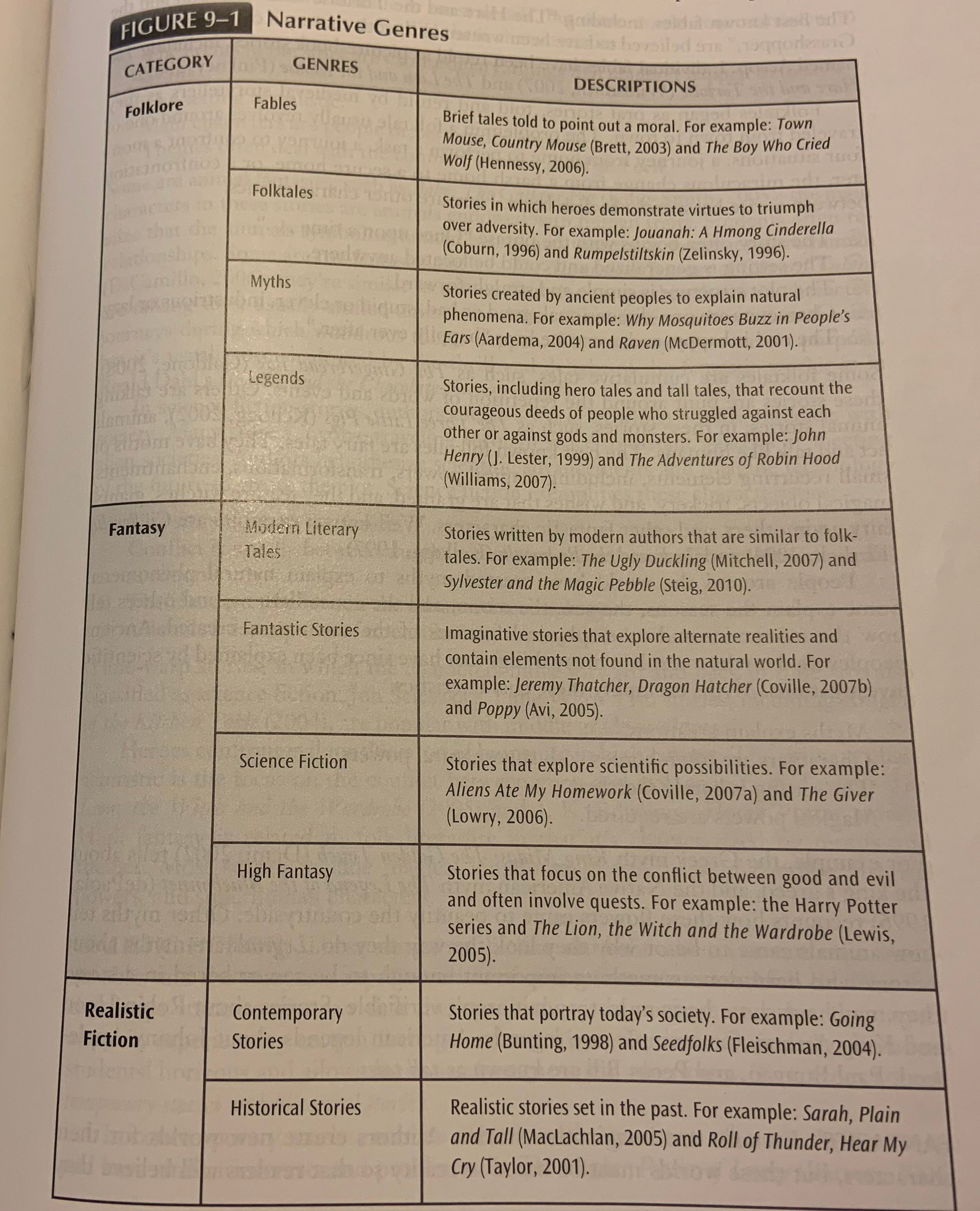
Elements of a Story Structure: Plot – The events that make up a story. Characters- the people or personified animals in the story. Setting (Has four demensions)- location, or a predicatable setting the contributes to the effectiveness of the story. weather, which is essential to the plot development of the story. time period, where the story is set to take place like in the past or future. time, involves both time of day and passage of time. Point of View (Has four viewpoints): First person viewpoint, tells the story through the eyes of one character using hte first-person pronoun I. Omniscient Viewpoint, author is godlike, seeing and knowing all, telling readers about the thought process of each character without worrying about how information is obtained. Limited Omniscient Viewpoint, told in third person where the author concentrates on thoughts, feelings and experiences of the main character. Objective Viewpoint, readers are eyewitnesses to the story and are confined to the immediate scene, they learn only what is visible and audible and are not aware of character feelings. Theme-underlying meaning of the story
Narrative Devices-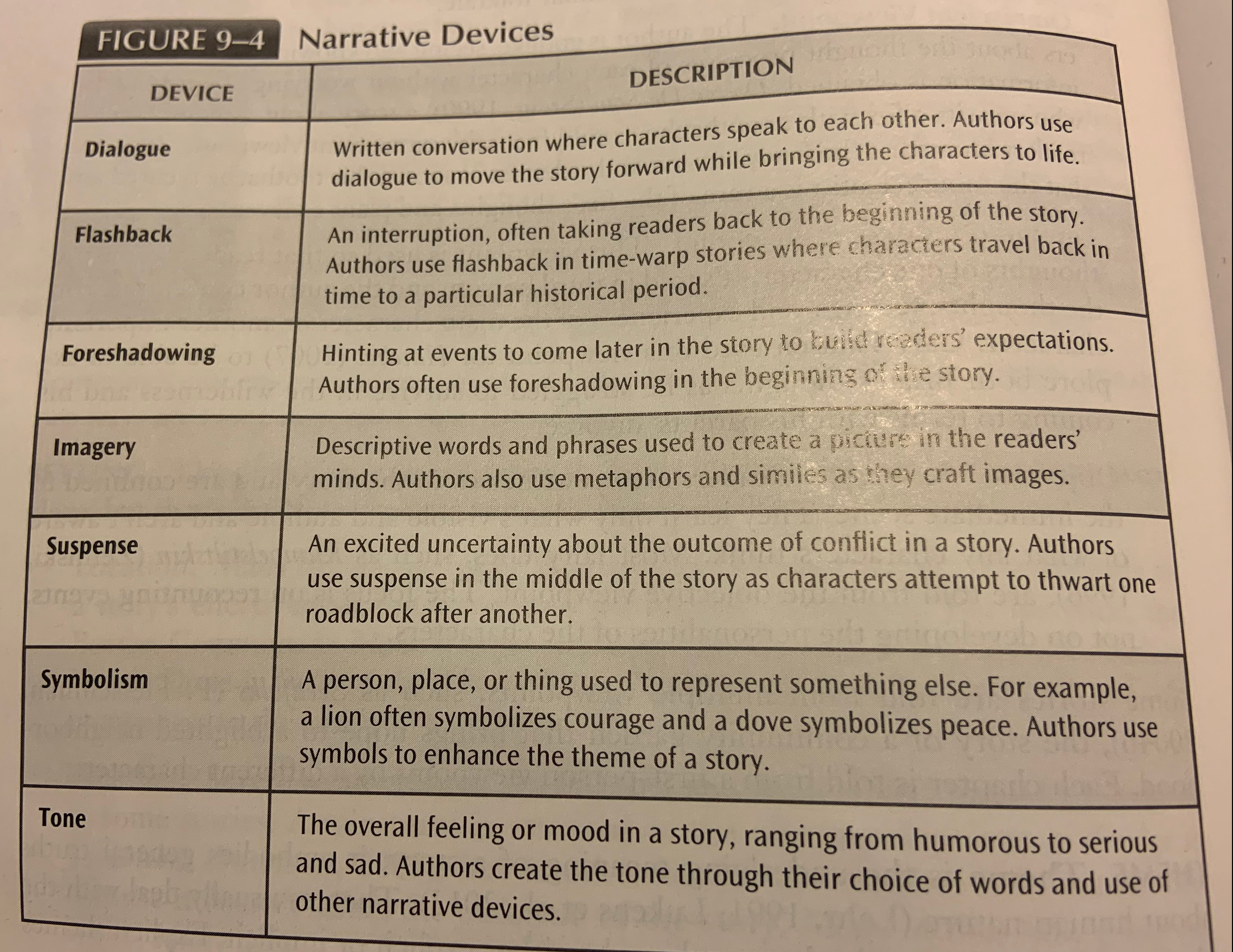
Text Factors of Nonfiction Books- Include things such as headings and subheadings to direct readers attention to the big idea, use of photos and drawings to help illustrate the big idea and they sometimes have figure, maps, and tables to provide diagrams and detailed information visually.
Expository Text Structures- Are organized into five expository text structures that include description, sequence, comparison, cause and effect and problem and solution.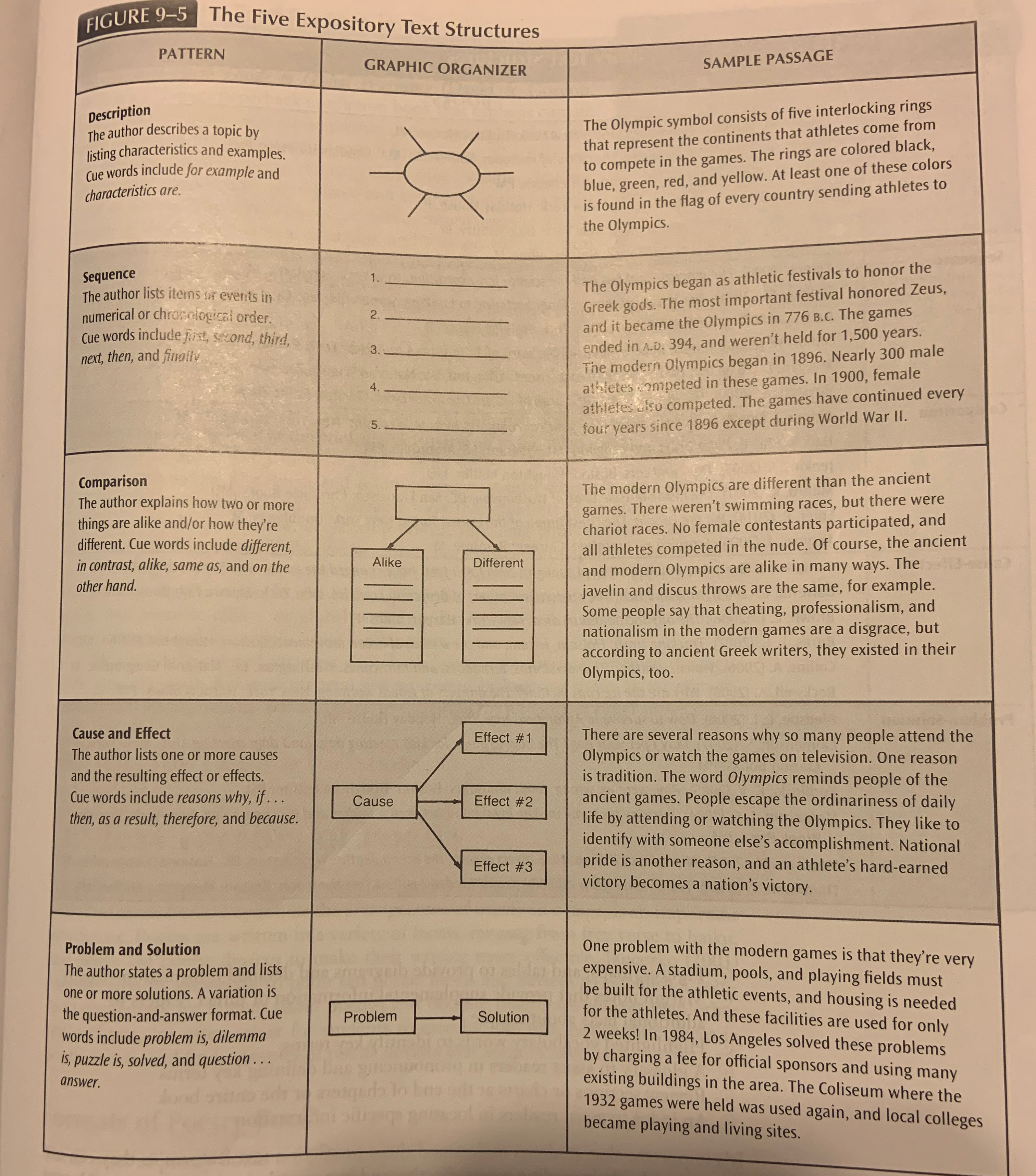
Text Factors of Poetry- The layout or arrangement of words on a page, is important text factor. Poems are written in a variety of ways ranging from free verse to haiku. Poems are shorter than other types of text making it easier for students to examine.
Formats of Poetry- There are three types of poetry books they include picture-books, specialized collections of poems, and comprehensive anthologies.
Poetic Forms: Ryhmed Verse– has rhyming vowel sounds at particular moments. Narrative Poem- a metered poem that tells a story with clear objectives. Haiku- Japanese poetic form that contains 17 syllables arranged in three lines of 5-7-5 syllables. Odes- celebrate everyday objects. Unrhymed and written directly to a specific object and tells what is good about the object and why it is valued. Concrete poems- visual poetry where the typographical effect is more important in conveying meaning than verbal significance. Free Verse– poetry that is free from limitations of regular meter or rhythm and does not rhyme with fixed forms.
Assessing Text Factors: Planning- text factors are determined and how they will monitor student progress is determined. Monitoring- Student progress is observed through conferencing about their reading and writing. Notes of students understanding is recorded on a log. Evaluating- Students are encouraged to apply their knowledge of genres, structural elements and literary devices done using rubrics or checklists. Reflecting- students are asked to think about how they are growing in their ability to use text factors to comprehend complex texts. Teachers also think about their own effectivness.
Application to Classroom- Students are taught to use knowledge of genres, structural elements, and literary devices to help increase comphrension of complex texts. Students are taught that stories have unique text factors; narrative genres, story elements and narrative devices. Students are taught that nonfiction books have unique text factors: nonfiction genres, expository text structures, and nonfictions features. Students are taught that poems have unique text features: book formats, poetic forms and poetic devices. Students are taught about text factors and the role they play in comprehension.
Videos:
Myths, Fables and Folktales – Myth, a short story that explains why something is the way it is. It usually teach a lesson and involves magic. Fables, are short stories used to teach a moral or lesson and animals are often the main character. Folktales, are short stories that have been told orally from one generation to the next.
The Grasshopper and the Ants- A fable where the moral of the story is that you work today for what you will need tomorrow.
Fiction Book Genres: What is a Fantasy- Fantasy is imaginary, make believe or pretend and comes from visions or dreams and contains unreal things or characters.
Fiction Book Genres: What is Science Fiction- Contains unreal things that could be real in our world in the future. Explores when things go wrong with tools or advancements and takes place in real world or a world with similiar rules.
Realistic Fiction- Are stories that could happen in real life. The characters are human and the setting takes place in the world as we know it. A story that seems true but comes from the authors imagination.
NonFiction Text Features- Help you make sense of what your reading and what information will be most helpful to the reader.
Story time with Berly: My Parents Think I’m Sleeping- This is a poetry book where the main character reads under his covers at night as he watches shadows dance on his wall.
 Amanda Jachthuber